
Excluded by Design
How America’s Safety Net Leaves the Displaced Nowhere to Land
With a closer look at why single adults—particularly men—often fall through the cracks
THE ASSUMPTION OF RECOVERY
The public narrative around homelessness is deceptively simple:
Find work. Get back on your feet. Move forward.
But this expectation assumes something rarely examined—
that a person has the minimum stability required to recover.
In reality, for many Americans, homelessness does not begin with addiction or long-term unemployment.
It begins with sudden displacement—a legal order, a financial collapse, a domestic separation—followed by a system that offers fragments of help, but no foundation to rebuild.
When stability disappears overnight, recovery is no longer a matter of effort.
It becomes a matter of access.
On any given night, more than 650,000 people in the United States are experiencing homelessness, according to the United States Department of Housing and Urban Development. Rising rents, stagnant wages, and limited affordable housing continue to push more people to the edge.
In places like Florida’s Space Coast, those pressures are increasingly visible.
What begins as a disruption—a job loss, a separation, an eviction—can quickly become something else entirely.
A fall without a floor.
Recovery requires stability—and for many, that stability disappears overnight.
DISPLACEMENT WITHOUT A PATH BACK
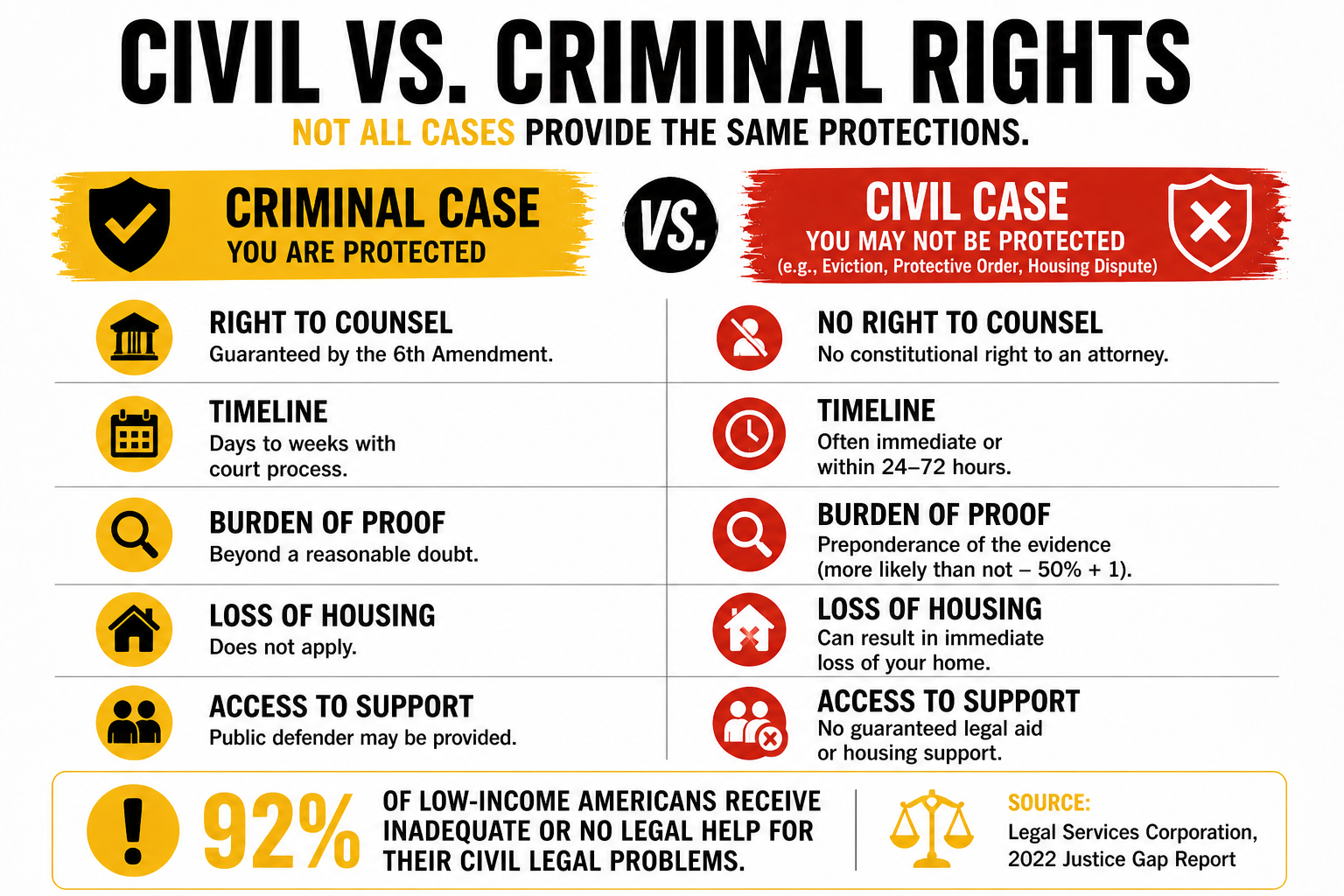
Civil legal mechanisms—protective orders, evictions, and emergency rulings—can remove individuals from their homes with little notice.
Unlike criminal proceedings, civil cases do not guarantee legal representation, even when the consequences include immediate loss of housing (Legal Services Corporation).
According to the Legal Services Corporation, 92% of low-income Americans receive inadequate or no legal help for their civil legal problems.
The result is immediate destabilization:
Loss of shelter
Loss of belongings
Loss of financial access
This is not a transition.
It is a structural drop.
Many never fully return.
“I’ve been out here over 20 years… staying wherever I can.”
WHO THE SYSTEM PRIORITIZES
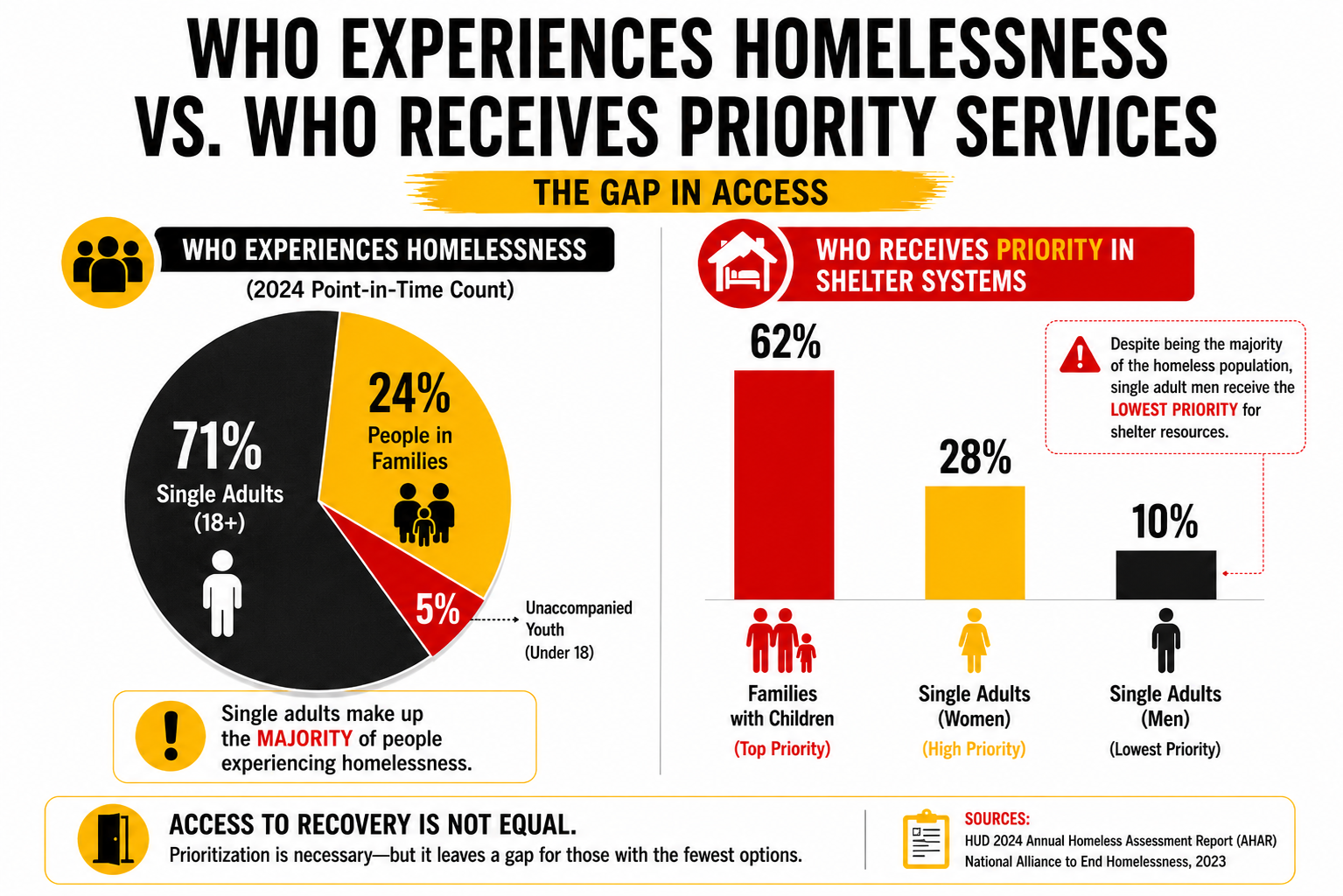
Homeless assistance systems are designed to prioritize the most visibly vulnerable—particularly families with children and survivors of domestic violence.
This prioritization is intentional and necessary.
However, it creates structural gaps.
Data from the United States Department of Housing and Urban Development shows that single adults make up the majority of the homeless population, yet family-focused resources receive significant prioritization in shelter allocation and program design.
Additionally, national counts indicate that men represent roughly 60–70% of the homeless population (HUD Point-in-Time data).
Single adults—especially men—often encounter:
Fewer dedicated shelter beds
Lower prioritization in coordinated entry systems
Longer wait times for housing placement
This is not about worth—it is about resource allocation under constraint.
But the outcome is clear:
Access to recovery is not evenly distributed.
“I’ve been on the housing list for years… nothing ever came from it.”
“People get on the list after me… and get help before me.”
Placement is influenced by a range of factors—risk assessments, program eligibility, available funding.
But for those outside priority categories, the result can feel indistinguishable from absence.
SURVIVAL, NOT RECOVERY
While food banks and clothing programs are widely available, housing remains the scarcest resource.
Without stable shelter:
Sleep becomes unsafe
Hygiene becomes difficult
Belongings cannot be secured
Cognitive performance declines
Research from the National Alliance to End Homelessness emphasizes that unsheltered homelessness is associated with higher rates of physical and mental health deterioration.
At this stage, recovery is no longer the objective.
Survival is.
Without shelter, daily life reorganizes around risk.
“The hardest part is finding somewhere safe to sleep… without getting arrested.”
“I’ve been jumped three times in the last few weeks.”
“When you sleep… you worry about being robbed.”
Unsheltered individuals face significantly higher rates of violence, illness, and early death, according to the National Alliance to End Homelessness.
Sleep is not restorative.
It is conditional.
THE JOB YOU CAN’T GET WITHOUT A PLACE TO LIVE
“Get a job” is often framed as the solution.
But employment requires infrastructure:
A phone
Clean clothing
Transportation
Reliable rest
Without these, job-seeking becomes structurally limited.
According to the Urban Institute, barriers such as lack of identification, transportation, and communication access are among the top obstacles preventing re-employment among homeless populations.
The system assumes capacity that homelessness removes.
Work is often framed as the solution. But the ability to work depends on conditions that homelessness removes.
“You need somewhere to sleep… to keep a job.”
“You need a good night’s rest to be who they want you to be at a job.”
Research from the Urban Institute identifies lack of stable housing as a key barrier to sustained employment.
Expectations remain unchanged.
The conditions required to meet them do not.
WHEN THERE’S NOWHERE TO GO
Policies regulating public space increasingly affect those without shelter.
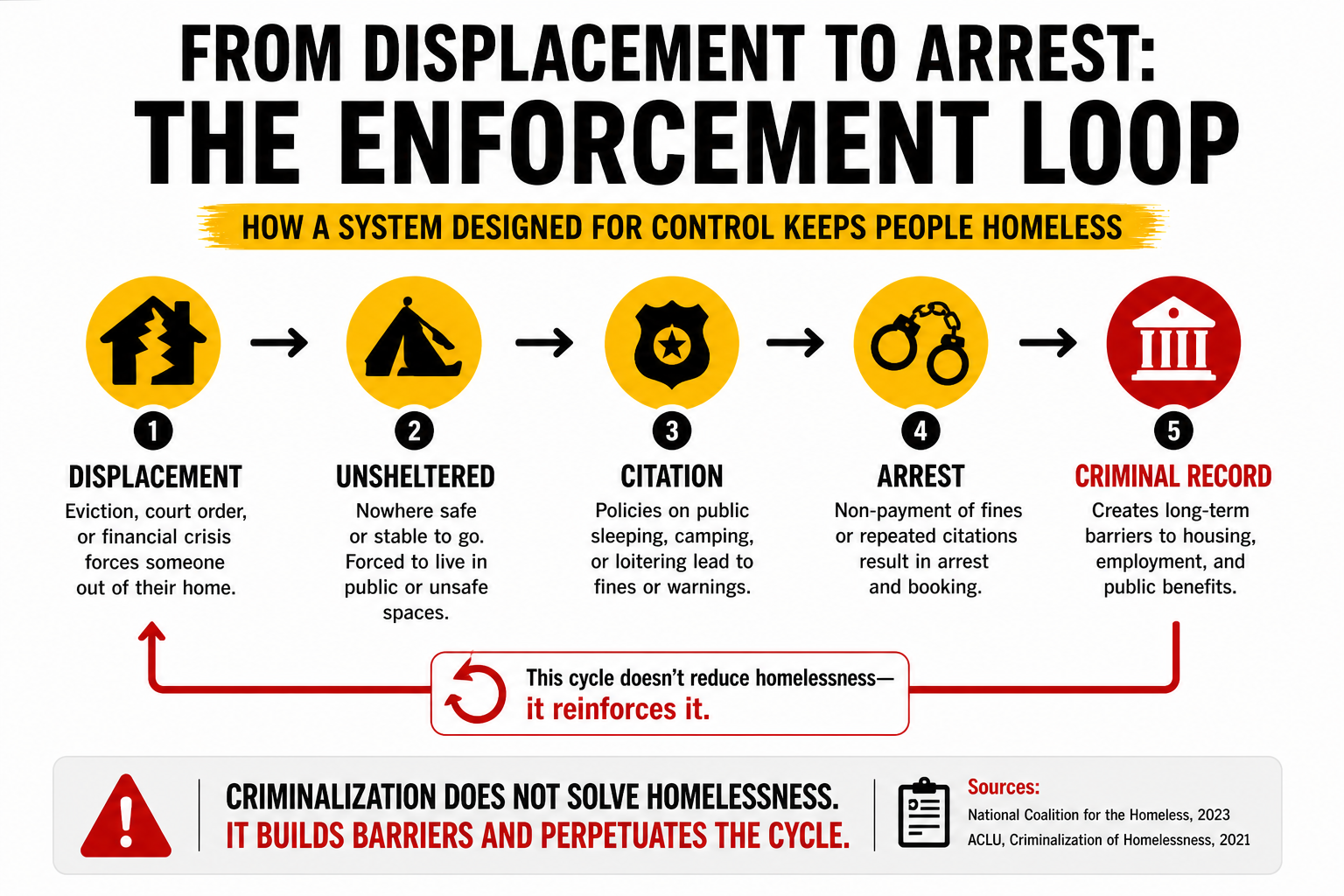
Florida has new laws HB 1365 (2024), new restrictions on public camping and sleeping expanded enforcement mechanisms across the state.
For individuals with nowhere to go, this creates a predictable chain:
Displacement
Public presence
Citation or arrest
Criminal record
According to the National Coalition for the Homeless, criminalization policies do not reduce homelessness—they increase barriers to employment and housing, perpetuating the cycle.Policies governing public space shape where people can exist—and for how long.
“If you stay in one place too long… you get trespassed.”
“Every day… they push you out.”
For individuals without access to shelter, the distinction between regulation and removal becomes difficult to separate.
THE PAPERWORK OF EXISTENCE
For individuals without housing, belongings are not optional—they are infrastructure.
Field reporting and legal advocacy organizations, including the American Civil Liberties Union, have documented patterns where homeless individuals’ property is confiscated, discarded, or lost during enforcement actions and sweeps.
Loss of property often includes:
Identification
Legal documents
Phones
Personal records
Without these:
Employment becomes inaccessible
Legal defense becomes limited
Communication becomes impossible
What is lost is not just material.
It is momentum.
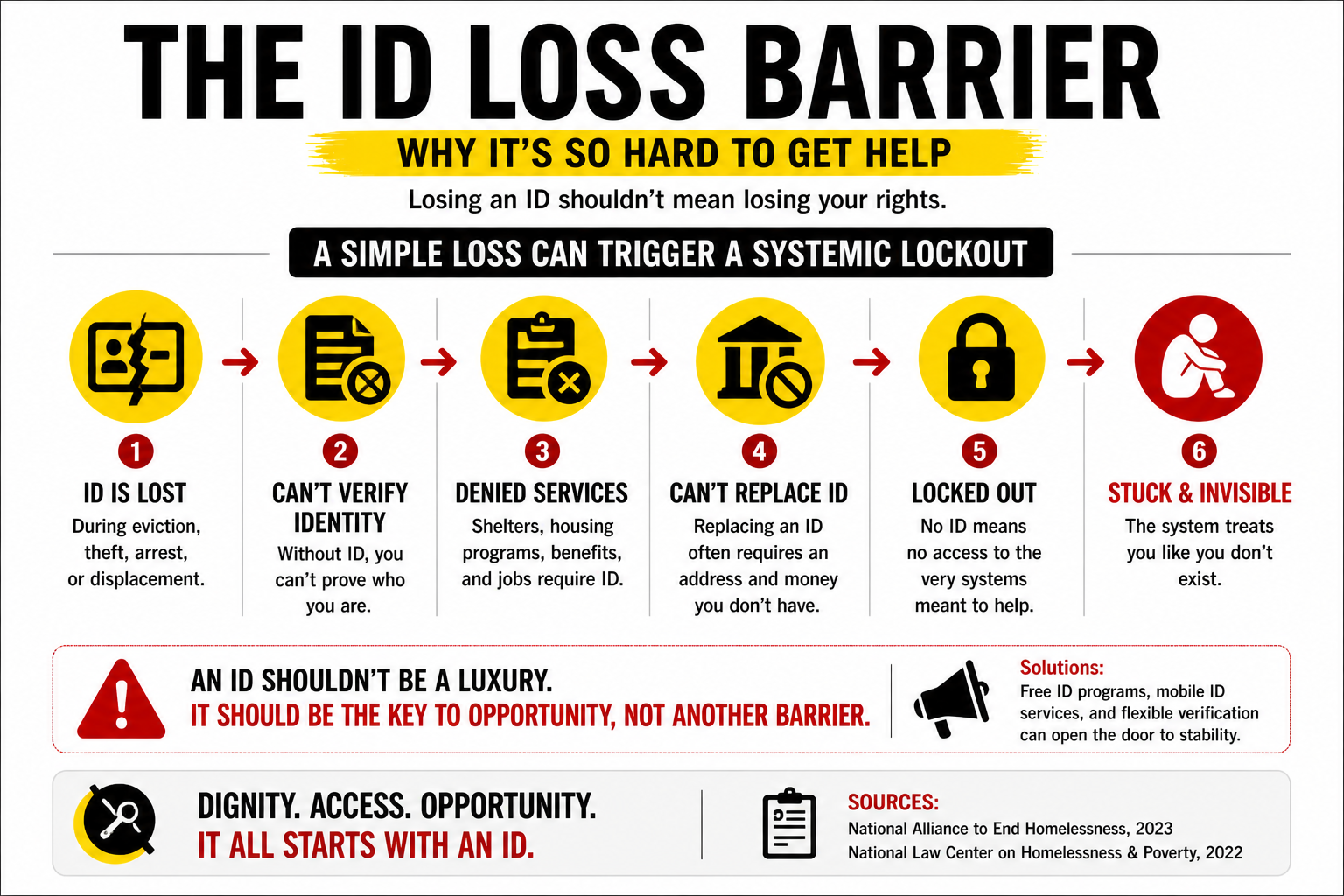
Identification is often the difference between access and exclusion.
“Without an ID… you don’t exist.”
Without it, securing employment, accessing services, or even replacing the document itself becomes difficult.
The barrier is procedural.
The impact is total.
THE ECONOMIC CONTRADICTION
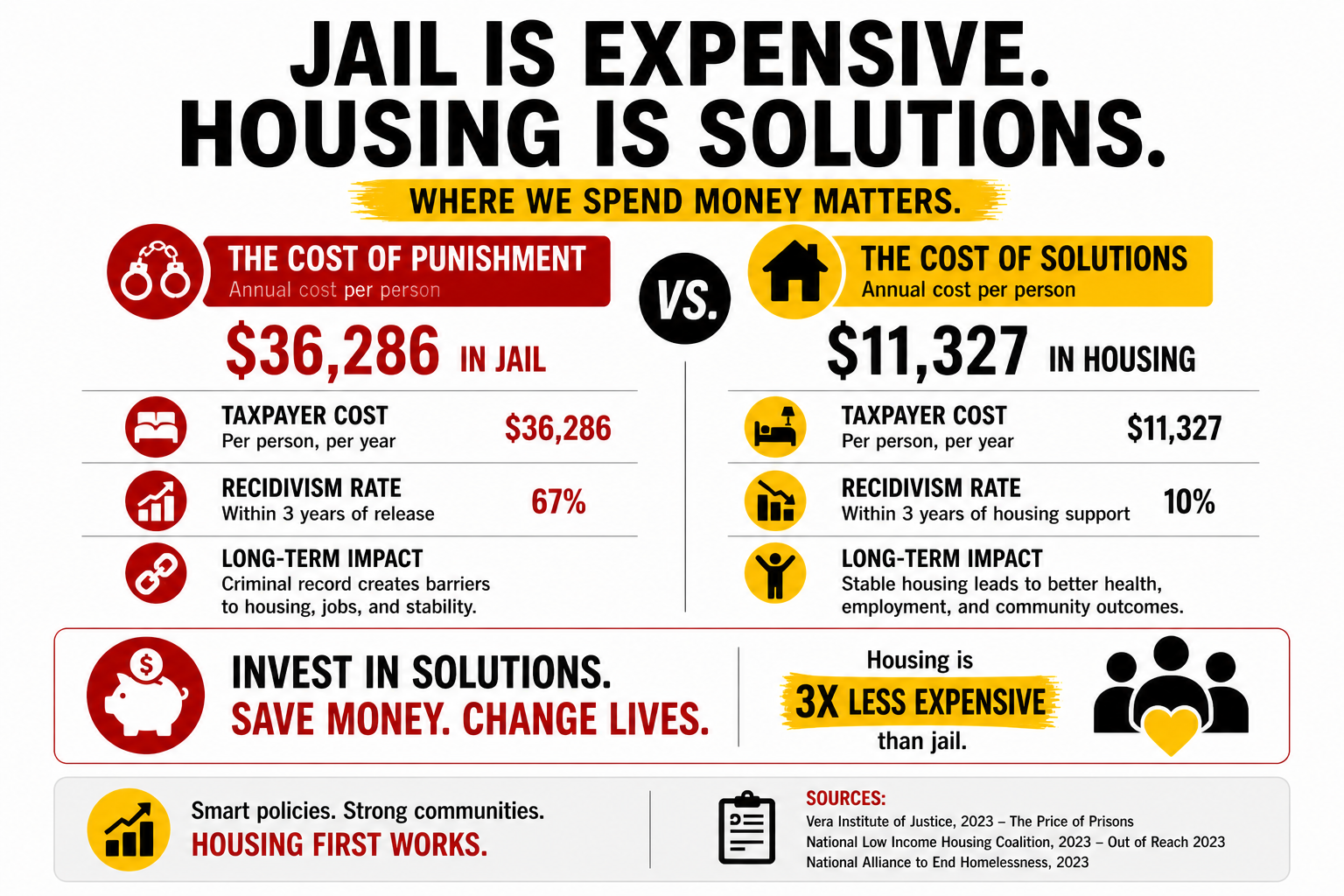
The current system is not only ineffective—it is costly.
Research compiled by the United States Interagency Council on Homelessness shows that supportive housing programs reduce reliance on emergency services, law enforcement, and incarceration.
Studies have found:
Housing First programs often produce net cost savings or cost neutrality
Emergency services and jail costs can exceed housing costs significantly
The National Low Income Housing Coalition reports that investments in permanent supportive housing consistently outperform reactive systems financially.
This reveals a core contradiction:
The system spends more managing homelessness than solving it.
Emergency response systems—law enforcement, hospitals, short-term detention—carry significant public costs.
Housing interventions, particularly those based on “Housing First” models, have been shown to reduce reliance on these systems, according to the United States Interagency Council on Homelessness.
“I gotta have a foundation before I can build.”
The logic is straightforward.
The implementation is not.
ON THE SPACE COAST
While homelessness affects all demographics, access to services is not evenly distributed.
Single adults—particularly men—often face:
Fewer targeted programs
Reduced prioritization
Increased exposure to unsheltered conditions
This is not a failure of compassion.
It is a limitation of system design under constrained resources.
But for those outside priority categories, the result is the same:
Fewer doors.
Longer waits.
Greater risk.
In Brevard County, the dynamics reflect national patterns with local consequences.
Housing shortages, population growth, and limited shelter capacity intersect in ways that make stability difficult to maintain—and even harder to regain.
“There’s not really a lot of places here.”
Data from Brevard County Government and regional housing groups indicate ongoing gaps in affordable housing and emergency services.
The problem is visible.
The solutions remain limited.
BEYOND A SINGLE STORY
Not all homelessness is visible.
Many individuals:
Live in cars
Stay in temporary or hidden areas
Move frequently to avoid enforcement
According to HUD data, a significant portion of the homeless population is unsheltered, making them less visible but more vulnerable.
Their invisibility reflects adaptation—not absence.Homelessness resists simple explanation.
“They think we’re all the same.”
WHERE IT BEGINS AGAIN
Across interviews, one idea appears consistently—not as policy, but as necessity.
“If I had a safe place to stay, I’d be alright.”
Current interventions provide partial relief:
Food
Clothing
Temporary aid
But without housing, these cannot scale into recovery.
The Urban Institute has found that temporary and fragmented assistance alone does not significantly reduce long-term homelessness without stable housing solutions.
Without a foundation, the cycle continues:
Survival
Enforcement
Re-entry Housing is often treated as the end of recovery.
For many, it is the beginning.
CONCLUSION: A STRUCTURAL GAP, NOT A PERSONAL FAILURE
Homelessness is often framed as an individual failure.
But the evidence points elsewhere.
It is a systems problem:
Housing shortages
Fragmented services
Misaligned incentives
When access to recovery depends on availability and prioritization,
some individuals will inevitably fall through.The systems that respond to homelessness are not absent.
They are incomplete.
They feed, but do not house.
They regulate, but do not place.
They expect, but do not equip.
When access to recovery depends on availability and prioritization,
some individuals will inevitably fall through.
And in that space between expectation and access, people remain—
visible, but unsupported.
