
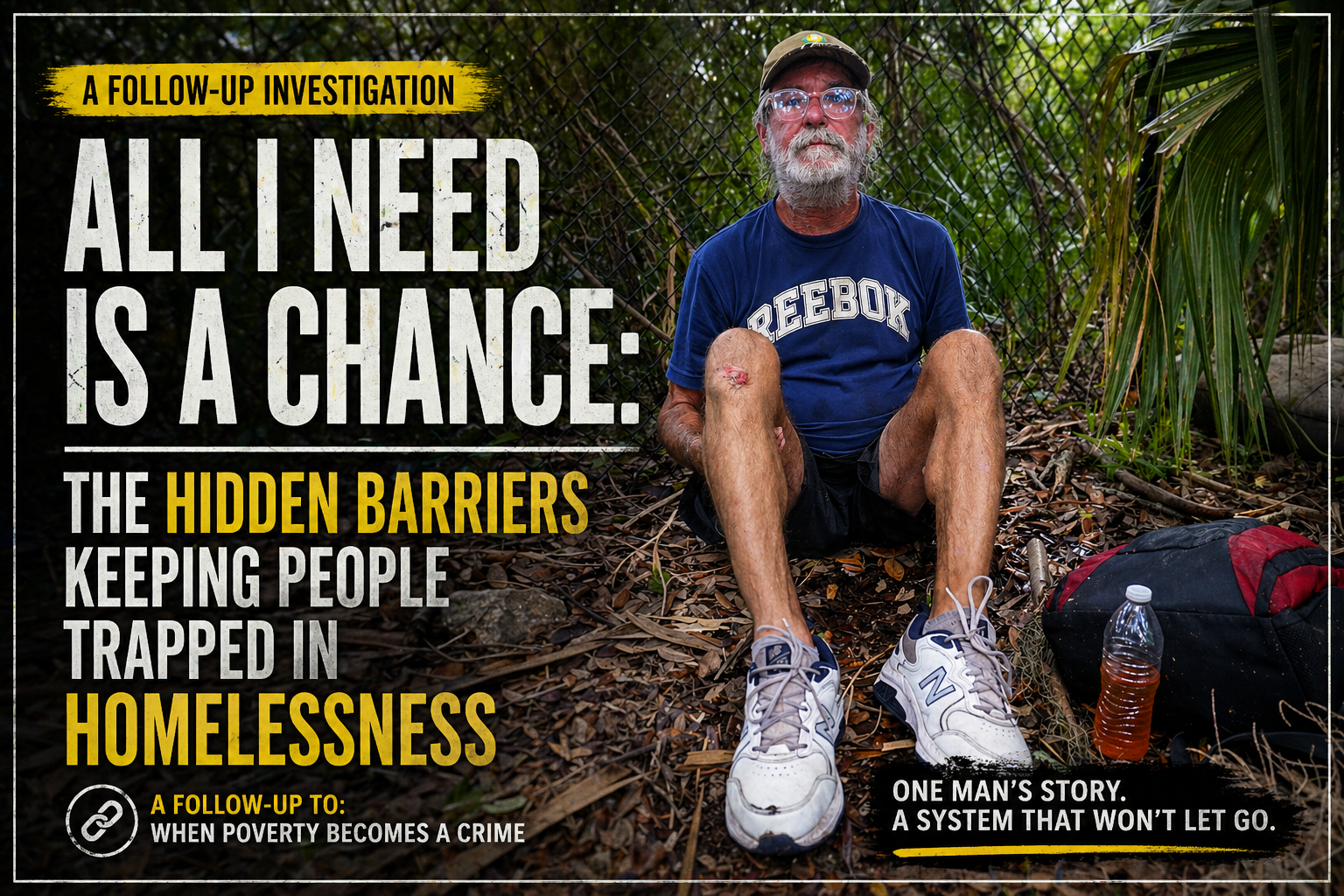
All I Need Is a Chance: A Follow-Up on the Hidden Barriers Keeping People Trapped in Homelessness
A follow-up to my investigation on homelessness in Brevard County, this story reveals how barriers like lack of ID, communication access, and basic resources keep people trapped in cycles of survival.
In my investigation, “When Poverty Becomes a Crime: The Escalating Cost of Survival in Brevard County,” I examined how economic hardship intersects with enforcement systems, creating cycles that can deepen instability rather than resolve it.
This follow-up report expands that investigation through the story of one individual—Walter Henry Regeski III—whose experience reveals how those systemic barriers operate in real, daily life.
👉 Read the original investigation here:
A Working Life Before the Streets
Walter is not the stereotype many imagine when they think of homelessness.
Before losing housing, he operated a pool service business and spent years caring for his aging parents in Georgia. For nearly two decades, he helped care for family members as their health declined.
He describes himself simply:
“A good person. A hard worker.”
When his parents died, Walter was left to absorb the financial consequences alone:
Probate costs, foreclosure, and mounting instability.
Then came the next collapse.
His truck failed.
Without transportation, he lost his ability to work.
Without work, he lost income.
Without income, there was nowhere left to go.
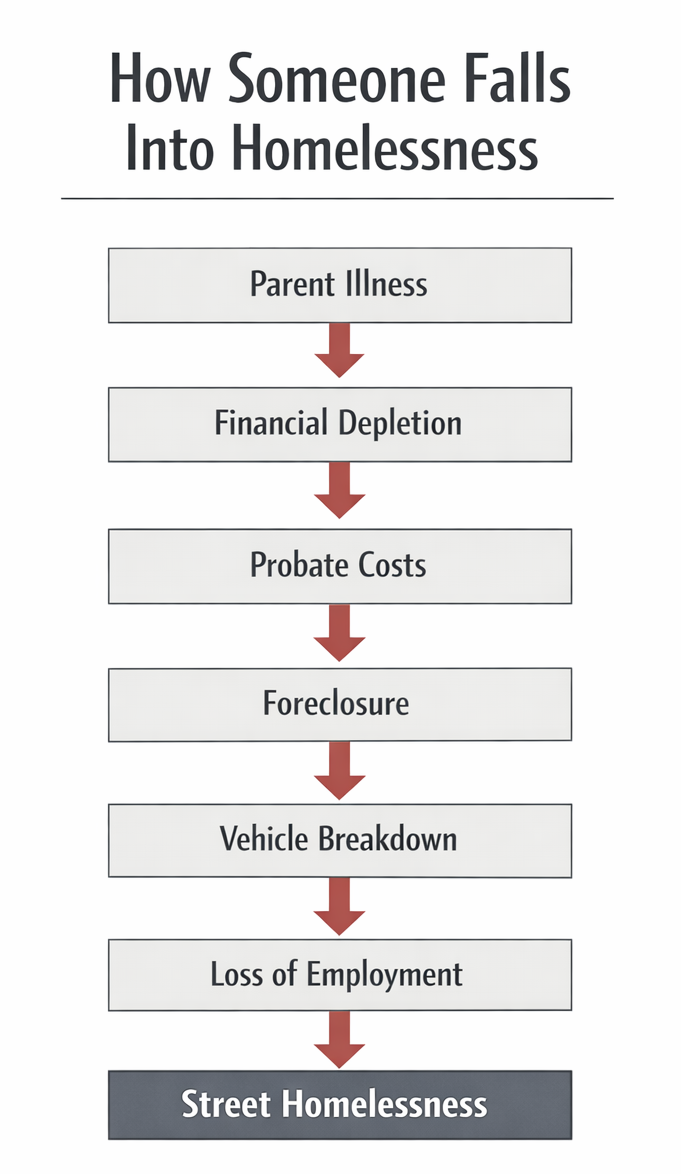
Chain of events leading to homelessness: vehicle failure, job loss, income loss, and housing instability.
Visual by Ricardo Stoyell.
Homelessness Is More Than the Loss of Shelter
Homelessness is often reduced in public discourse to a question of housing:
whether someone has a roof overhead or not.
But for those living it, homelessness is rarely caused by a single event
—and it is never solved by shelter alone.
It is often the result of cascading failures: illness, financial collapse, lost transportation, missing identification, lack of communication access, untreated trauma, and systems that demand stability before offering help.
Once someone falls into homelessness, the pathways back are often blocked by the very institutions meant to assist them.
Walter knows that reality intimately.
His story exposes what happens when a working life collapses under pressure—and how difficult recovery becomes when survival itself consumes every hour of the day.
“You have to have ID to do anything.”
Walter Henry Regeski III describing the challenges of living without identification and access to basic services. Interview by Ricardo Stoyell, Melbourne, Florida, April 2026.
The System Trap: Why Getting Back Becomes So Hard
Losing housing is one crisis.
Trying to recover without basic tools is another.
Walter identifies two barriers that define his inability to get back on his feet:
Identification
Communication Access
Without identification, he cannot apply for jobs.
According to the National Alliance to End Homelessness, lack of identification documents is one of the most common barriers preventing individuals from accessing employment, benefits, and housing services.
Without a phone, he cannot receive callbacks, verify appointments, contact agencies, or coordinate interviews.
“Without a phone… that’s the hardest part.”
These are not failures of effort.
They are failures of access.
Walter’s experience reflects the broader pattern identified in the original investigation:
The criminalization of poverty is not always immediate, but it is structural.
When individuals lack access to identification, communication, and stable resources, even basic survival becomes a barrier to recovery. These conditions increase the likelihood of interaction with enforcement systems, missed obligations, and deeper instability.
What begins as economic hardship can evolve into a cycle of exclusion—one where the systems intended to support recovery instead reinforce the conditions that prevent it.
As explored in a related investigation, “The Price of Freedom,” financial barriers also extend into the criminal justice system, where poverty determines access to freedom even before trial.
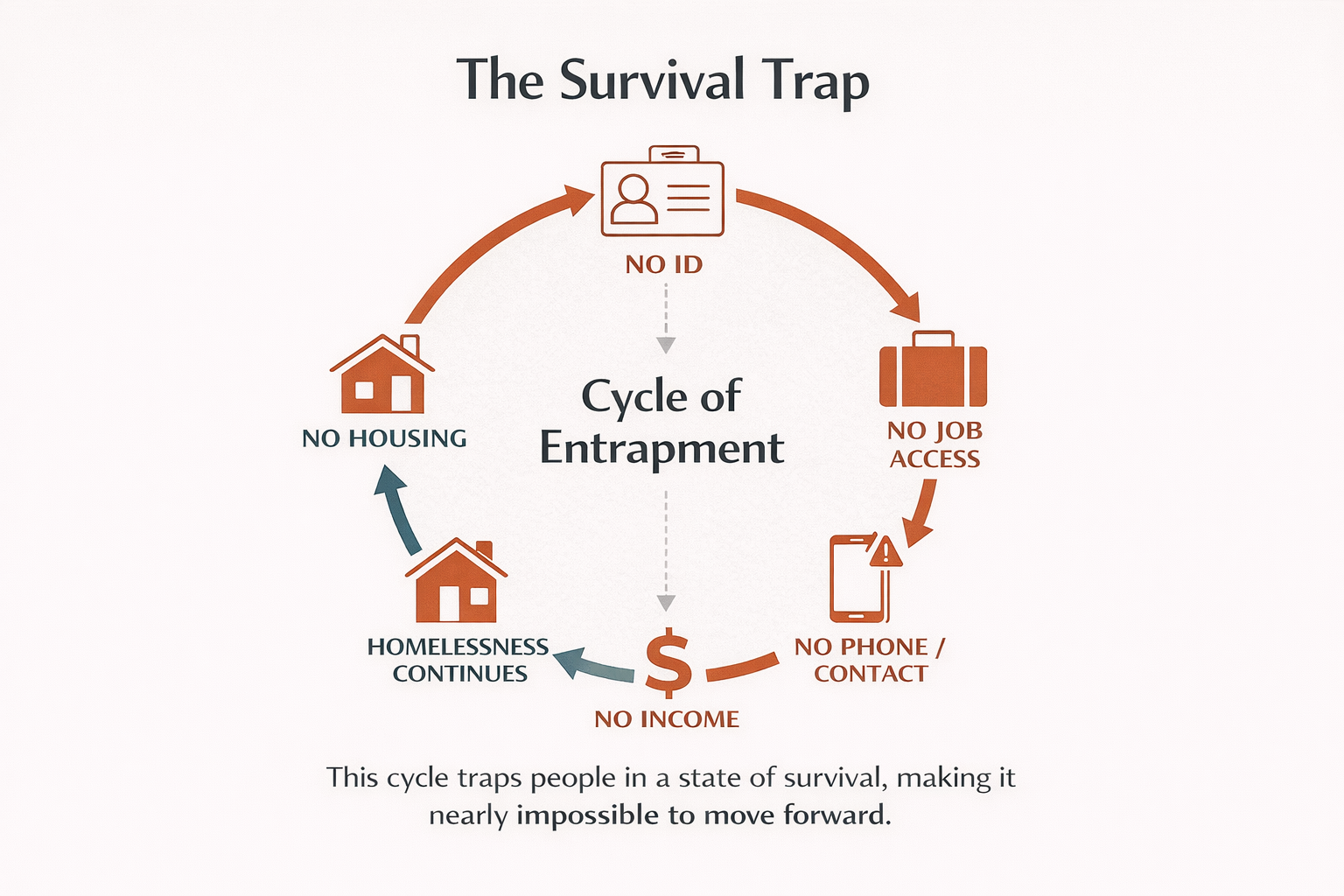
Structural barrier loop: lack of ID, communication, and income prevents reentry into housing and employment systems. Visual by Ricardo Stoyell.
Survival Becomes Full-Time Labor
Walter’s days are governed by uncertainty.
Each morning begins with basic maintenance:
securing shelter
protecting belongings
searching for food
finding ways to survive
By nightfall, the task shifts to safety.
Rain floods campsites. Theft is common. Sleep is fragmented.
“24 hours… survival 24 hours a day.”
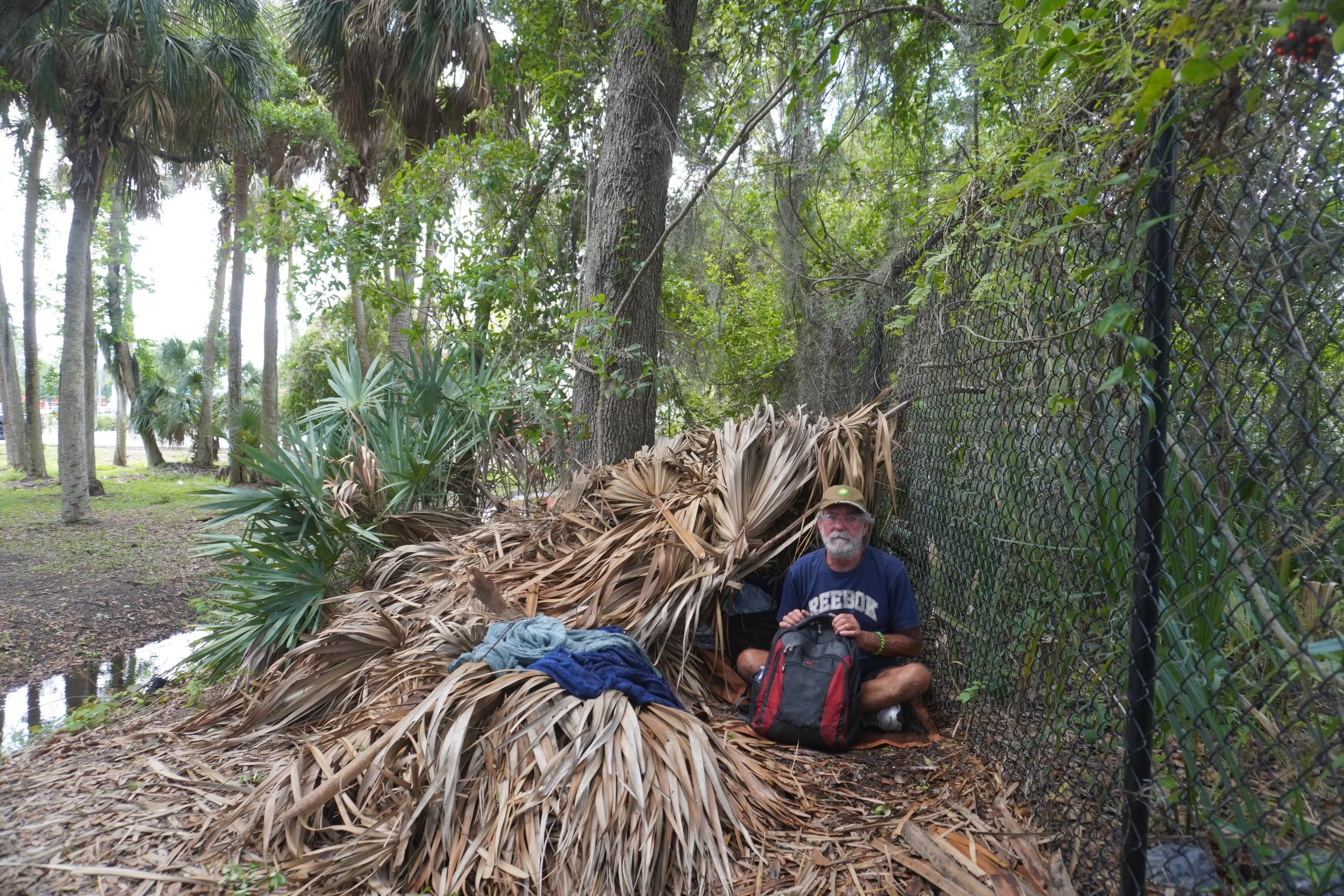
Exterior view of Walter’s shelter constructed from palm fronds and salvaged materials in Melbourne, Florida.
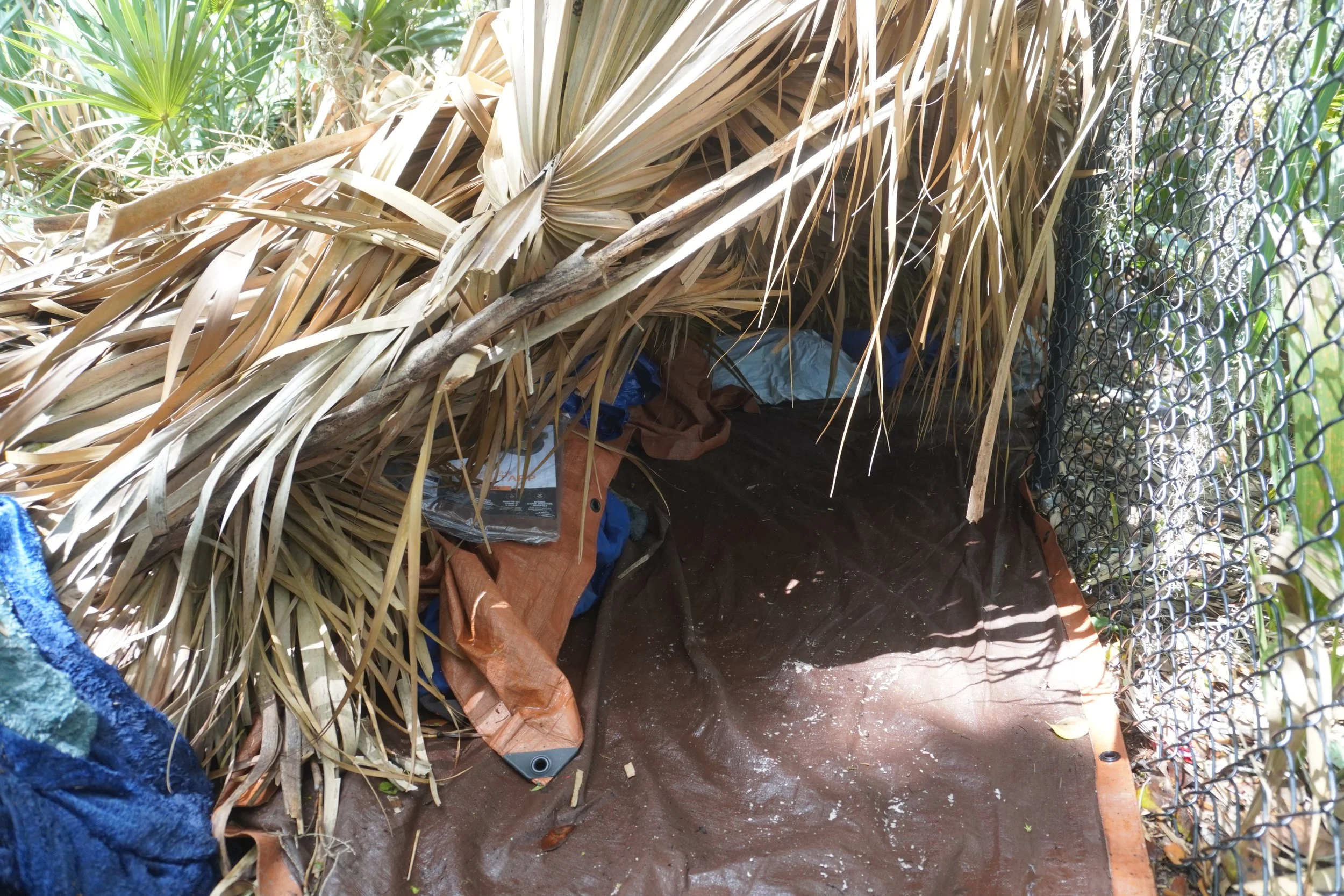
Interior view of tarp-covered sleeping space showing minimal protection from environmental exposure.
Walter describing daily survival conditions while living unsheltered. Interview by Ricardo Stoyell, April 2026
The Psychological Cost No One Sees
The visible hardships of homelessness are easier to document than the invisible ones.
Walter describes the mental erosion that accompanies prolonged instability:
“It makes you feel worthless.”
“Your mind starts to go.”
“Half the time I don’t know what day it is.”
This is the psychological cost of living without continuity, safety, or certainty.
Walter reflecting on the psychological effects of prolonged homelessness.
Danger Is Constant
Living unsheltered is not only exhausting—it is dangerous.
Walter recounts the story of Tina, another homeless woman in the area, who was attacked while sleeping outdoors.
“She got hit in the head with a hammer…”
She survived.
Many do not.
Violence against unhoused individuals remains chronically underreported despite elevated rates of victimization nationwide.
According to the U.S. Department of Housing and Urban Development (HUD), unsheltered individuals face significantly higher rates of assault and victimization.
What Actually Helps
Walter does not describe abstract solutions.
His proposals are practical:
Safe shelter
Phone access
ID recovery assistance
Employment pathways
Transitional support
What he outlines is not charity.
It is infrastructure.
The Florida Council on Homelessness identifies these same factors as critical to successful reentry into stable housing and employment.
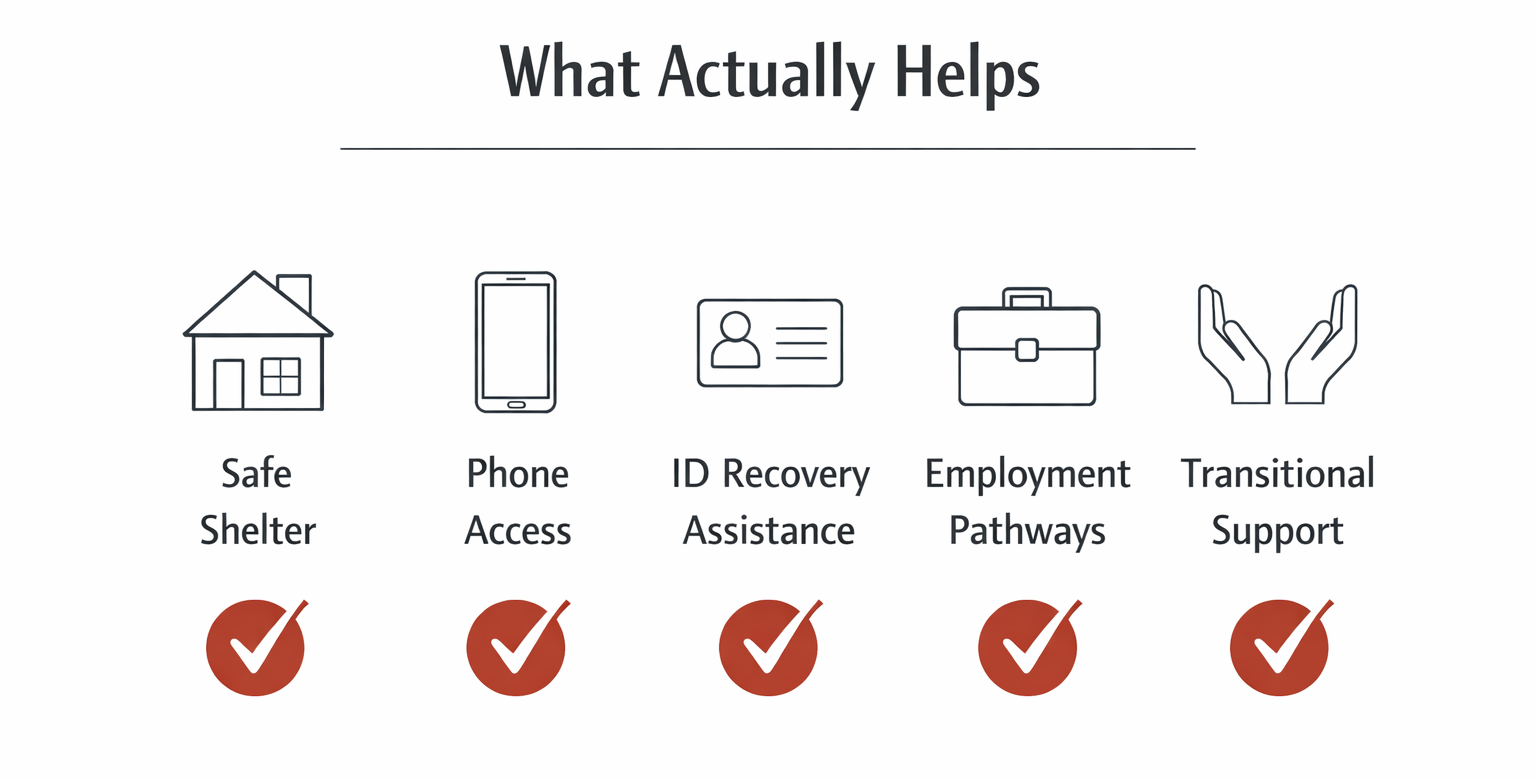
Key recovery factors: identification, communication, shelter, and employment pathways as foundational support systems
“All I Need Is a Chance”
Walter’s requests are modest.
He is not asking for sympathy.
He is asking for reentry.
“I want a house.”
“I want a job.”
“I want my life back.”
“All I need is a chance.”
Walter’s closing statement on rebuilding his life.
FOLLOW-UP CONCLUSION
Walter’s story is not an isolated case—it is a continuation of the patterns identified in “When Poverty Becomes a Crime.”
His experience demonstrates how systemic barriers do not simply delay recovery—they actively shape a cycle in which poverty, exclusion, and enforcement intersect.
This follow-up reveals that the criminalization of poverty is not only a matter of policy, but a lived reality that unfolds through everyday barriers to access.
Without structural changes—access to identification, communication tools, and stable pathways to employment—individuals remain trapped in cycles that are nearly impossible to escape.
This is not a failure of effort.
It is a failure of access.
SOURCE ATTRIBUTION
Primary Source:
Interview with Walter Henry Regeski III conducted by Ricardo Alan Stoyell, Melbourne, Florida, April 2026.
Photography & Video:
Original field reporting, photography, and video by Ricardo Alan Stoyell.
🔗 REFERENCES
U.S. Department of Housing and Urban Development (HUD)
https://www.huduser.gov/portal/datasets/ahar.html National Alliance to End Homelessness
https://endhomelessness.org Florida Council on Homelessness
https://www.myflfamilies.com
📝 EDITORIAL NOTE
This article is part of ExposeTheSilence.org’s ongoing investigative coverage of homelessness, systemic poverty, and barriers to recovery in Florida communities
Why Evidence Matters in Conversations About Homelessness
Public conversations about homelessness often move faster than the facts. This video examines financial vulnerability, national trends, and why evidence — not assumptions — should guide public understanding.
Public conversations about homelessness often move quickly — sometimes faster than the facts.
Headlines circulate.
Opinions form.
Narratives harden.
But context matters.
According to the Federal Reserve, a significant percentage of U.S. adults would struggle to cover a $400 emergency expense using cash or its equivalent.
Financial instability is not rare. It is widespread.
At the same time, national homelessness counts have increased in recent years.
Local communities, including Brevard County, reflect broader economic pressures.
This video is not about advocacy.
It is about methodology.
Assumptions can cause harm.
Evidence builds trust.
Before drawing conclusions, we should ask:
What context is missing?
Can it be verified?
ExposeTheSilence.org exists to approach difficult topics with documentation, restraint, and accountability.
Independent Journalism.
Brevard County | National Reporting.

America the Beautiful… But Broken
America the Beautiful… But Broken” is a visual and narrative exposé revealing the hidden costs of a system that drives people into poverty, addiction, and despair. Beneath the anthem and the flag lies a society where survival itself has become criminalized. This project seeks to expose the silence around systemic injustice — not out of hate for America, but out of love for what it could still become.
America is beautiful — but beneath its anthem and ideals lies a quiet suffering that most never see.
During my time living without a home, I came face to face with a system designed not to heal, but to contain.
Families, veterans, and workers — people who once believed in the promise of the American Dream — now fight simply to survive a cycle of poverty and addiction created by the very institutions meant to protect them.
Through this lived experience, I witnessed both the darkness of neglect and the light of human resilience.
Communities built from nothing, people sharing food and hope in empty lots, strangers becoming family in the face of abandonment.
In those moments, I realized that reform cannot exist without compassion — and that human dignity must never be a privilege reserved for the few.
That realization gave birth to Spiritus Invictus, a movement devoted to restoring purpose, dignity, and empowerment to those who have been silenced by poverty and prejudice.
From its foundation came ExposeTheSilence.org — the journalistic arm dedicated to shining a light on the unseen realities of homelessness, incarceration, and social injustice across America.
Through storytelling, evidence, and truth, we aim to transform awareness into action.
The background track, “God and My Right,” is my own composition — a reflection of survival, purpose, and the divine strength that kept me standing through impossible times.
It serves as the heartbeat of this story: a call to rise, rebuild, and reclaim what it means to be free.
Reform is the only way forward.
All people deserve dignity and truth.
We are not statistics — we are the reckoning that reminds America what it was meant to be.
Related Links
Spiritus Invictus Foundation – A nonprofit dedicated to recovery, dignity, and justice.
ExposeTheSilence.org – Investigative journalism exposing systemic injustice.
Full Sail University – New Media Journalism Program – Where storytelling and advocacy meet.
Featured Image: “America the Beautiful… but Broken”
Video: Narrated Slideshow
Music: “God and My Right” – Original composition © 2025 Ricardo Stoyell / The Alchemical Brother

The Power of Storytelling: Creating Impact Through New Media
Discover how authentic storytelling, empowered by new media, can drive social impact, elevate voices, and inspire transformation. This blog explores the intersection of journalism, branding, and human rights to help individuals and organizations create narratives that matter.
Storytelling has always been at the heart of human connection.
Today, through the tools of new media, we have the power to inspire change, spark action, and build stronger communities by sharing authentic narratives.
As a communicator and strategist, I believe that every story holds the potential to create impact — when shared truthfully and strategically.
This blog will explore the intersection of journalism, branding, and human rights, offering insights, strategies, and real-world examples to empower individuals and organizations to find and share their voice.
Stay tuned for stories that matter, conversations that inspire, and tools to create your own transformation.

Why Expose The Silence Exists
Every day, stories of abuse, corruption, and systemic failure are swept under the rug.
Expose The Silence was created to give voice to the voiceless.
This platform delivers investigative reporting and courageous journalism to uncover what others fear to reveal.
This isn’t just journalism—it’s justice.
Every day, stories of abuse, corruption, and systemic failure are swept under the rug.
Expose The Silence was created to give voice to the voiceless.
This platform delivers investigative reporting and courageous journalism to uncover what others fear to reveal.
This isn’t just journalism—it’s justice.