
Why escaping homelessness in Brevard County can be far more difficult than simply finding a shelter or getting a job.
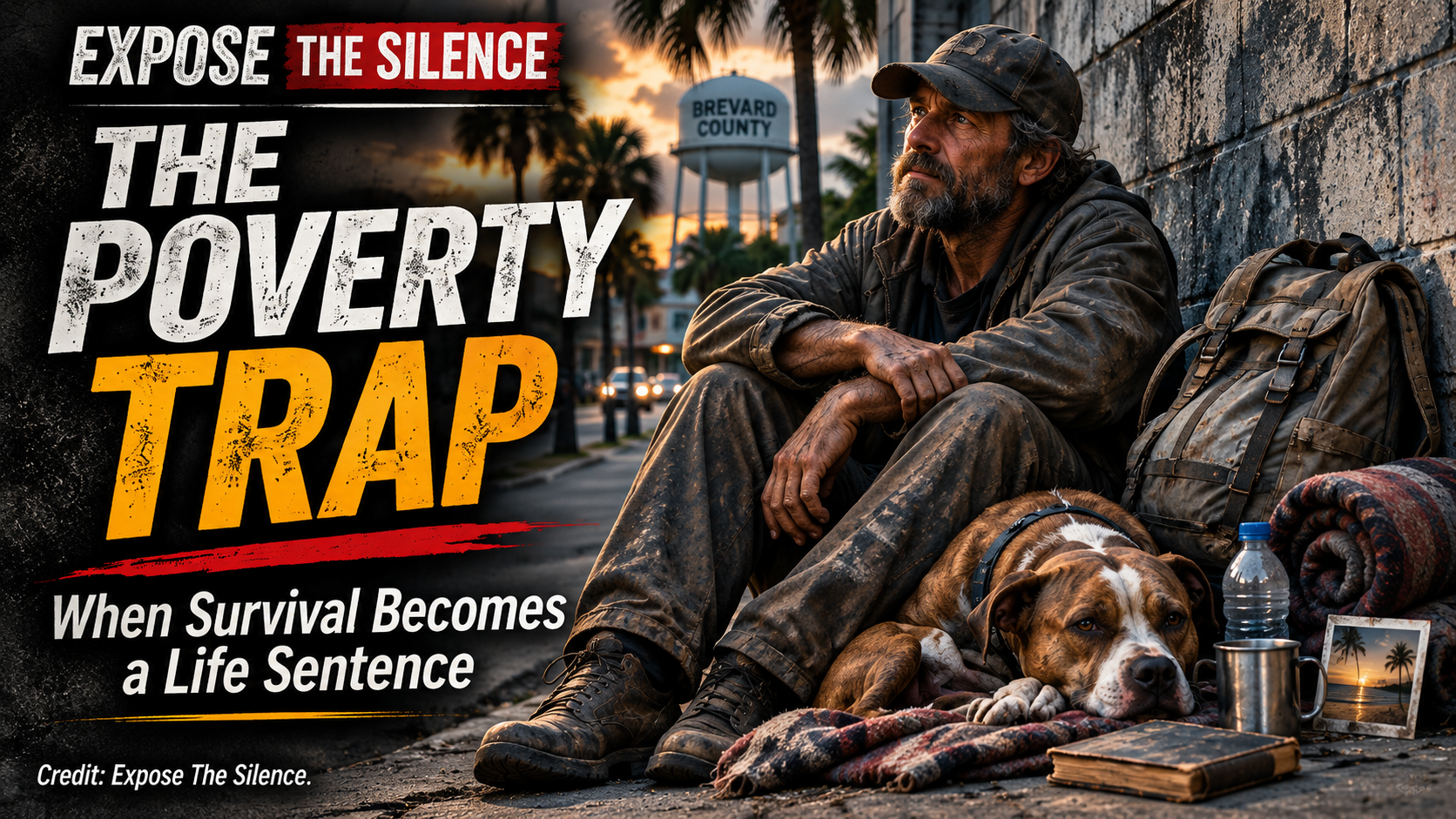
The Illusion of Choice
"Why would anyone choose to sleep on the streets when homeless shelters exist?"
It's a question frequently asked by people who have never experienced homelessness.
The assumption is simple: If someone is living outside, sleeping in a car, or surviving in an encampment, they must be refusing the help available to them.
But what happens when that help isn't actually accessible?
What happens when the nearest program requires someone to surrender their pet, commit to months of structured living, meet religious participation requirements, or pass a background screening?
What happens when a person desperately needs employment but has no stable address, unreliable transportation, a criminal record, and nowhere to shower before a job interview?
And what happens when someone wants to rebuild their life but discovers that every opportunity requires resources they have already lost?
The problem isn't always a refusal to accept help. Sometimes the problem is that the pathways out of homelessness are obstructed by the very circumstances homelessness creates.
In Brevard County, Florida, the numbers and the eligibility requirements of existing programs reveal why this conversation deserves greater scrutiny.
A Homelessness Crisis in Our Own Backyard
According to the Brevard Homeless Coalition's 2026 Point-in-Time Count, conducted January 22, 2026, 1,039 people were experiencing homelessness across the county.
Of those, 618 were unsheltered, while 421 were in emergency shelters, transitional housing, or safe havens.
The report also found that 88% of unsheltered people first lost their housing in Brevard County.
This is not simply a problem arriving from outside the community. It is a crisis affecting people who were already living here.
Perhaps even more revealing is that 97% of the unsheltered population consisted of individuals rather than families.
These numbers raise a critical question: Are our housing programs structured to meet the needs of the people actually experiencing homelessness?
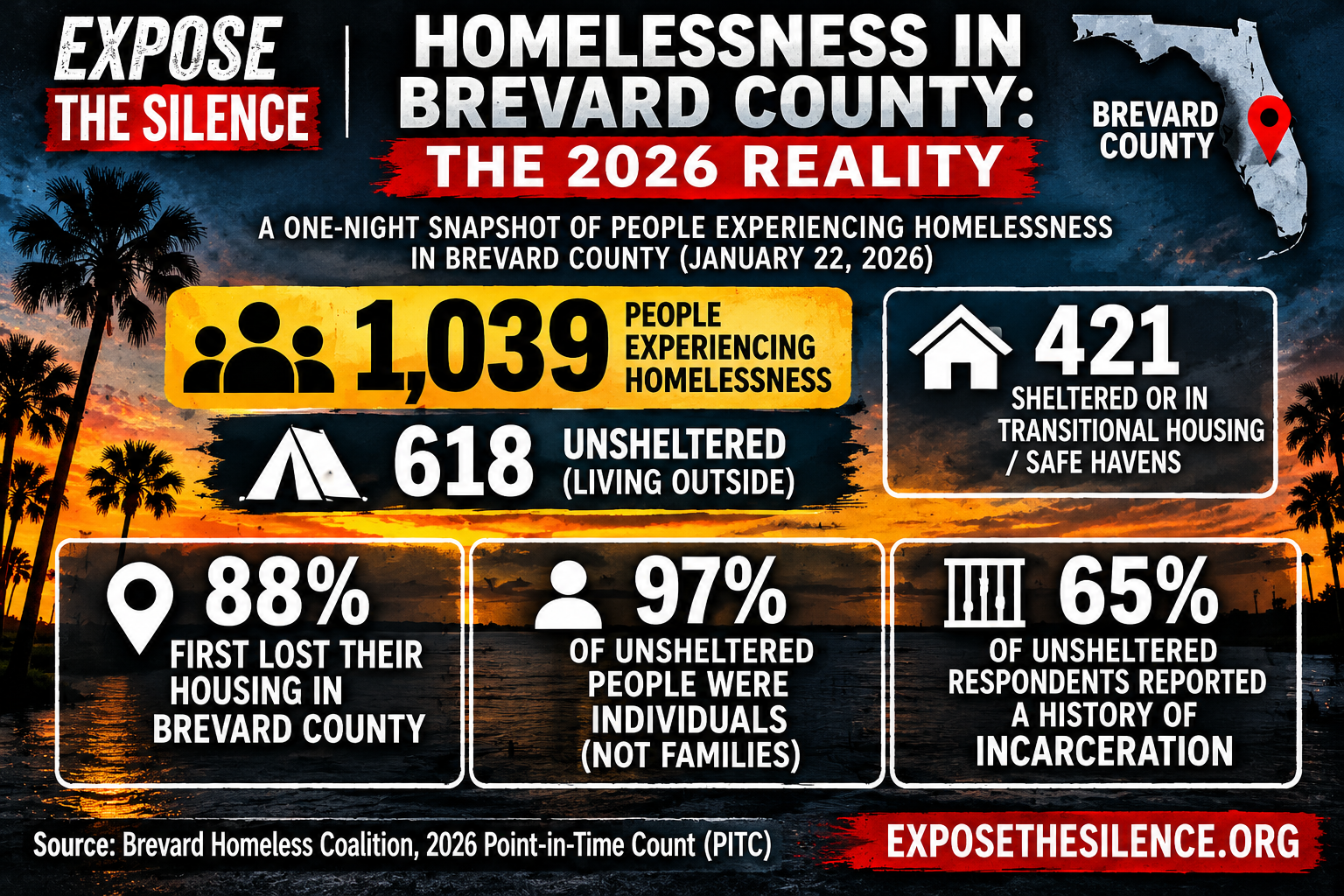
A one-night snapshot of homelessness in Brevard County. These figures describe people counted, not the number of immediately available shelter beds.
When Help Comes With Conditions
Brevard County has organizations working to assist people experiencing homelessness. Many provide valuable services, including food, housing, counseling, education, and recovery support.
Their contributions deserve recognition.
But it is equally important to examine who qualifies for these services, what participation requires, and who remains excluded.
Consider CITA Rescue Mission, a Melbourne organization that provides residential services for men.
According to its listing through 211 Brevard, the program:
Does not permit pets.
Excludes applicants with violent felony convictions.
Requires a commitment of at least 10 months.
Describes itself as a biblical-based program.
Does not initially permit outside employment, with participants able to begin seeking work after a minimum of 120 days.
For someone seeking long-term recovery and structured support, this may be an important opportunity.
But imagine a man who urgently needs to earn income, cannot leave his dog behind, or has a criminal history that disqualifies him.
What is his alternative?
Another organization, New Life Mission, offers a long-term residential program designed for women who have legal custody of children.
Its application requirements include participation in Bible studies, daily case management, and other structured activities. The organization explicitly states that it is not an emergency walk-in shelter.
Again, such programs can accomplish important work for the populations they serve.
But the existence of charitable programs does not automatically mean that accessible emergency housing exists for every person in need.
And religiously affiliated assistance raises another legitimate question: Should a person seeking basic shelter have access to an alternative when they cannot participate in a program's religious activities?
The issue is not whether faith-based organizations should be allowed to serve their communities. It is whether everyone else has somewhere to turn.
The Invisible Population: Single Men With Nowhere to Go
Consider the situation of a middle-aged man who loses his housing after divorce, unemployment, medical problems, or financial collapse.
He has no children living with him. He may not qualify for family-oriented programs.
He might have a minor criminal record, significant debt, or damaged credit.
Perhaps he has a dog that has remained beside him through everything.
He wants to work. He wants a home. He wants stability.
But what options exist for him tonight?
Not in six months. Not after completing a residential program. Not after he has solved his financial problems.
Tonight.
This is the difference between assistance that exists on paper and assistance that a person can actually access.
The distinction between single individuals and families also deserves further investigation. While Brevard's Point-in-Time Count documents that individuals represent the overwhelming majority of those unsheltered, it does not establish how many are men or quantify the unmet shelter needs of single men.
Those questions require direct examination of local capacity, eligibility rules, waiting lists, and actual shelter availability.
When Your Pet Is Your Last Remaining Family
For someone who has lost nearly everything, a companion animal may be their last consistent relationship.
A dog provides companionship, emotional security, routine, and a reason to keep moving forward.
Yet pet restrictions can force people into an impossible decision: Accept shelter and separate from the animal they love, or remain outside together.
This is not merely sentimentality.
The American Society for the Prevention of Cruelty to Animals (ASPCA) identifies restrictions on pets as a significant barrier to shelter access. It also discusses the emotional support, sense of responsibility, and stability that companion animals can provide to people experiencing homelessness.
A dog is not necessarily an unnecessary possession to discard.
For some people, that animal is family.
What does it say about our approach to homelessness when seeking safety can mean surrendering the one relationship that has survived everything else?
Programs must understandably address health, safety, space, and animal welfare. But that makes the development of pet-accommodating options an important question for service providers, not a reason to dismiss the people who need them.
Criminal Records: When the Past Becomes a Permanent Barrier
There is another obstacle that receives far too little attention.
The Brevard Homeless Coalition's 2026 findings indicate that 65% of unsheltered respondents reported a history of incarceration.
A criminal history can make the journey back into employment and housing particularly difficult.
Someone may have served their sentence, completed probation, or resolved an old case, yet continue to face background screening that limits their opportunities.
The Federal Trade Commission's guidance on tenant background checks explains that landlords and screening companies may consider employment and income history, credit reports, eviction records, criminal records, and past bankruptcies when assessing rental applications.
Imagine attempting to secure an apartment without savings, established income, or good credit while also carrying a record.
Now imagine trying to establish income when certain employers reject applicants based on background checks.
The result can become a cycle of exclusion.
Some people turn to day labor, temporary assignments, cash jobs, scrap collection, or informal work because those are among the opportunities they can access.
Such work may provide enough income for food or immediate expenses, but not necessarily the stable, documented earnings required to qualify for housing.
And work paid informally may offer no dependable benefits, predictable schedule, or reliable long-term security.
The issue is not that people with records are universally excluded from employment or housing. They are not.
The issue is that repeated barriers can make lawful economic recovery extraordinarily difficult, particularly when someone is already homeless.
The Economics of Being Poor
Poverty is expensive.
Without a home, maintaining basic necessities becomes an exhausting exercise in improvisation.
Food may cost more without access to refrigeration or cooking facilities.
Laundry, transportation, phone service, storage, and personal hygiene become daily logistical challenges.
Transportation problems can mean missing work. Missing work can mean losing income. Losing income can mean being unable to save for rent.
Even when someone manages to earn money, much of it may disappear into the immediate cost of survival.
A person can spend every day working and still be unable to accumulate enough for a security deposit and the first month's rent.
And even if they manage that, a damaged credit history or background screening can still prevent approval.
This is the poverty trap.
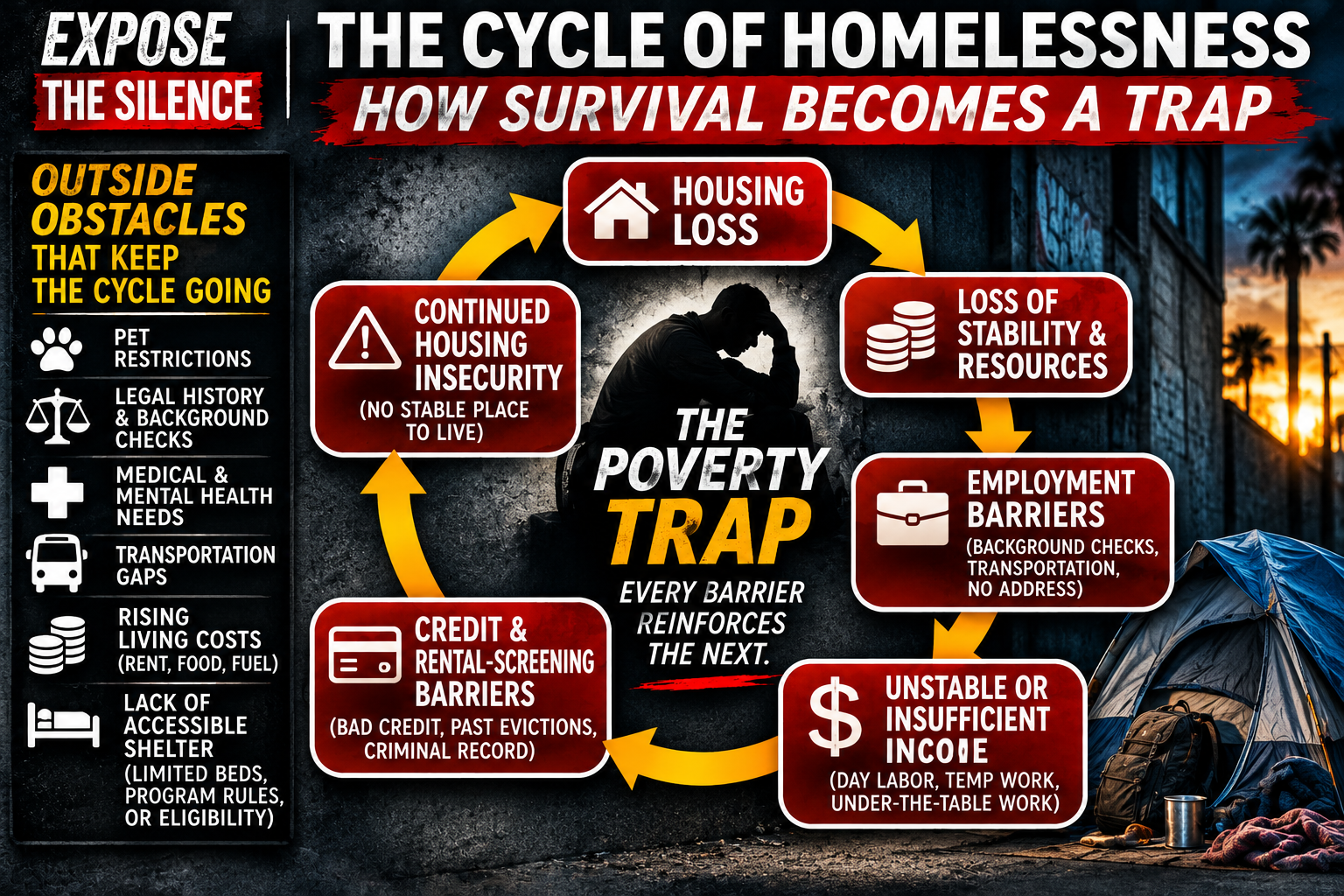
A conceptual illustration of interacting barriers to housing recovery. It is not a statistical model.
Mental Illness Is Not the Whole Story
One of the most damaging misconceptions about homelessness is that everyone living outside must be severely mentally ill, addicted to substances, or unwilling to work.
Brevard's 2026 Point-in-Time Count reported that approximately 21% of unsheltered people had a serious mental illness and 14% had a substance use disorder.
These are important needs deserving appropriate treatment and support.
But they do not describe everyone experiencing homelessness.
A 2024 peer-reviewed review in Social Science & Medicine examined studies of why some people remain unsheltered. Reported barriers included concerns about safety, strict shelter rules, inadequate conditions, and failure to accommodate particular needs.
People can experience homelessness for many overlapping reasons, including unaffordable housing, disrupted relationships, job loss, medical expenses, or insufficient income.
Reducing homelessness to an individual's choices can obscure the structural conditions that make recovery difficult.
The Criminalization of Survival
For people sleeping outside, finding somewhere to exist may itself become a struggle.
Public spaces are regulated. Private property owners can restrict access. Public sleeping and camping rules can further limit where someone can legally remain.
But prohibiting someone from sleeping in a particular place does not automatically create a safe alternative.
A person who cannot afford housing and cannot access an appropriate shelter still needs somewhere to sleep.
The larger policy question is whether restrictions on outdoor sleeping are accompanied by sufficient, realistic pathways into safe shelter and permanent housing.
Without those pathways, enforcement alone cannot resolve the underlying housing problem.
What Would a Real Pathway Out Look Like?
A meaningful response to homelessness must address more than immediate survival.
Food distributions and temporary assistance are essential. Faith-based organizations and volunteers play important roles.
But preventing homelessness from becoming chronic also requires options that accommodate people's actual circumstances.
Those options could include low-barrier emergency shelter, secular alternatives, pet-friendly accommodations, re-entry employment opportunities, assistance with identification and transportation, rental-deposit support, affordable housing, and individualized case management.
Just as importantly, communities need to measure outcomes.
How many people are being turned away from shelters?
How many beds are genuinely available tonight?
How many people cannot enter because of eligibility restrictions?
How many individuals obtain employment but still cannot afford housing?
How many people cycle repeatedly between shelters, streets, and incarceration?
These questions deserve answers grounded in public records, program data, and the firsthand experiences of people living through the crisis.
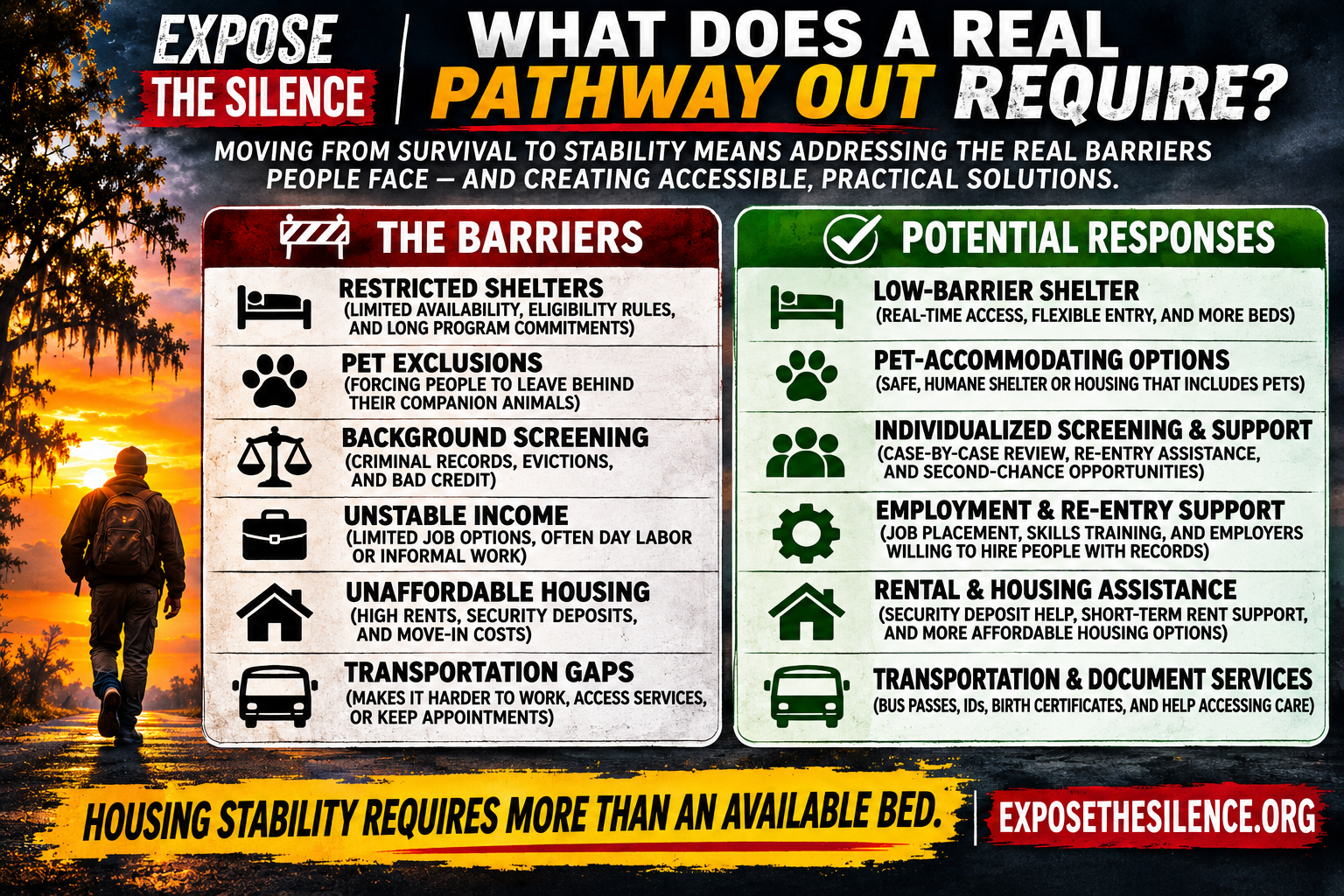
Housing stability requires more than an available bed.
Survival Should Not Become a Life Sentence
Behind every statistic is a human being.
A father.
A mother.
A veteran.
A person recovering from illness.
Someone who made mistakes.
Someone who lost a job, a marriage, a home, or the financial stability they spent years building.
Someone who still wants an opportunity to rebuild.
Through street outreach and conversations with people experiencing homelessness, the question becomes increasingly difficult to ignore:
How can we expect people to escape homelessness when the conditions of homelessness prevent them from accessing the opportunities required to escape?
It is easy to tell someone to get a job.
It is easy to tell someone to go to a shelter.
It is easy to tell someone to take personal responsibility.
But personal responsibility cannot, by itself, create affordable housing, eliminate employment barriers, or guarantee access to safe shelter.
Responsibility matters. So does opportunity.
A society that expects people to rebuild must also examine whether the tools needed to rebuild are genuinely within reach.
Because homelessness should not become a permanent punishment for financial failure, personal tragedy, or past mistakes.
Surviving another day is not the same as having a chance to rebuild your life.
And when every available path leads back to the same place, perhaps the question is no longer why people remain homeless.
Perhaps the question is why escaping homelessness has been made so difficult.
Sources and References
1. Brevard Homeless Coalition — 2026 Point-in-Time Count. Official local homelessness data, including sheltered and unsheltered counts, household composition, incarceration history, and housing inventory.
https://brevardhomelesscoalition.org/point-in-time-count-pitc/
2. Brevard Homeless Coalition — 2026 PIT Infographic. Original data visualization for the statistics in this article.
3. 211 Brevard — CITA Rescue Mission. Listed program eligibility, pet policies, employment restrictions, religious character, and length-of-stay requirements.
https://search.211brevard.org/search/594c7c16-cad6-5243-bd0f-df86dfba751b
4. New Life Mission — Program Application and Eligibility. Published requirements, eligibility criteria, religious participation, and emergency shelter limitations.
https://newlife-mission.org/apply/
5. ASPCA — People With Pets Experiencing Homelessness. Research summary on pet-related shelter barriers and the role of companion animals.
6. Federal Trade Commission — Tenant Background Checks and Your Rights. Information about rental screening, credit, criminal history, and employment documentation.
https://consumer.ftc.gov/articles/tenant-background-checks-and-your-rights
7. Tsai, J., Haley, G., & Kinney, R. L. (2024). Why some homeless individuals are unsheltered: A narrative review of self-reported reasons. Social Science & Medicine.
https://www.sciencedirect.com/science/article/pii/S0277953624006324
Reporting note: Program descriptions are based on publicly posted eligibility information. They do not establish current bed availability or every exception to admission rules. Additional interviews with providers and unhoused residents would be valuable follow-up reporting.

