
GUILTY UNTIL PROVEN WEALTHY?

There are certain ideas we grow up accepting without ever stopping to question them.
That freedom of speech matters.
That everyone is equal before the law.
That a person is innocent until proven guilty.
It is one of the most recognizable principles of the American justice system. We hear it in classrooms, on television, in political speeches, and inside courtrooms themselves. It represents something most of us want to believe—that justice doesn't belong to the rich or the powerful, but to everyone.
Lately, I've found myself wondering whether people still believe that promise.
Not what lawyers think.
Not what politicians think.
What ordinary people think after experiencing the legal system themselves.
There was only one way to find out.
I grabbed a camera, a microphone, and started asking a single question.
"When you hear the phrase 'innocent until proven guilty,' what does it mean to you?"
The first answer caught me completely off guard.
When I listened to the recording again later that evening, one thing struck me.
She never paused to think about her answer.
She laughed.
Not because the question was funny.
Because, for her, the answer seemed obvious.
"That's a joke... You're guilty until you can prove yourself innocent... if you have the money."
I wrote six words in the margin of my notebook.
One interview proves absolutely nothing.
But it gives you a place to start.
So I kept asking.
The next few conversations couldn't have been more different.
Different ages.
Different backgrounds.
Different life experiences.
Some had been through criminal cases.
Others had dealt with family court, housing instability, or financial hardship.
No one knew what anyone else had said.
I wasn't looking for people to agree with each other.
I was looking for honesty.
By the time I reviewed the interviews, I noticed one word appearing in my notes again and again.
Access.
Not whether justice exists.
Whether people believed they could actually reach it.
That wasn't enough to support a conclusion.
It was enough to make me ask another question.
If these experiences reflected something larger, would the research show it?
DO THE NUMBERS TELL THE SAME STORY?
I left the interviews and started reading.
Legal aid organizations.
Public defense studies.
Academic research.
Court statistics.
One report kept appearing no matter where I looked.
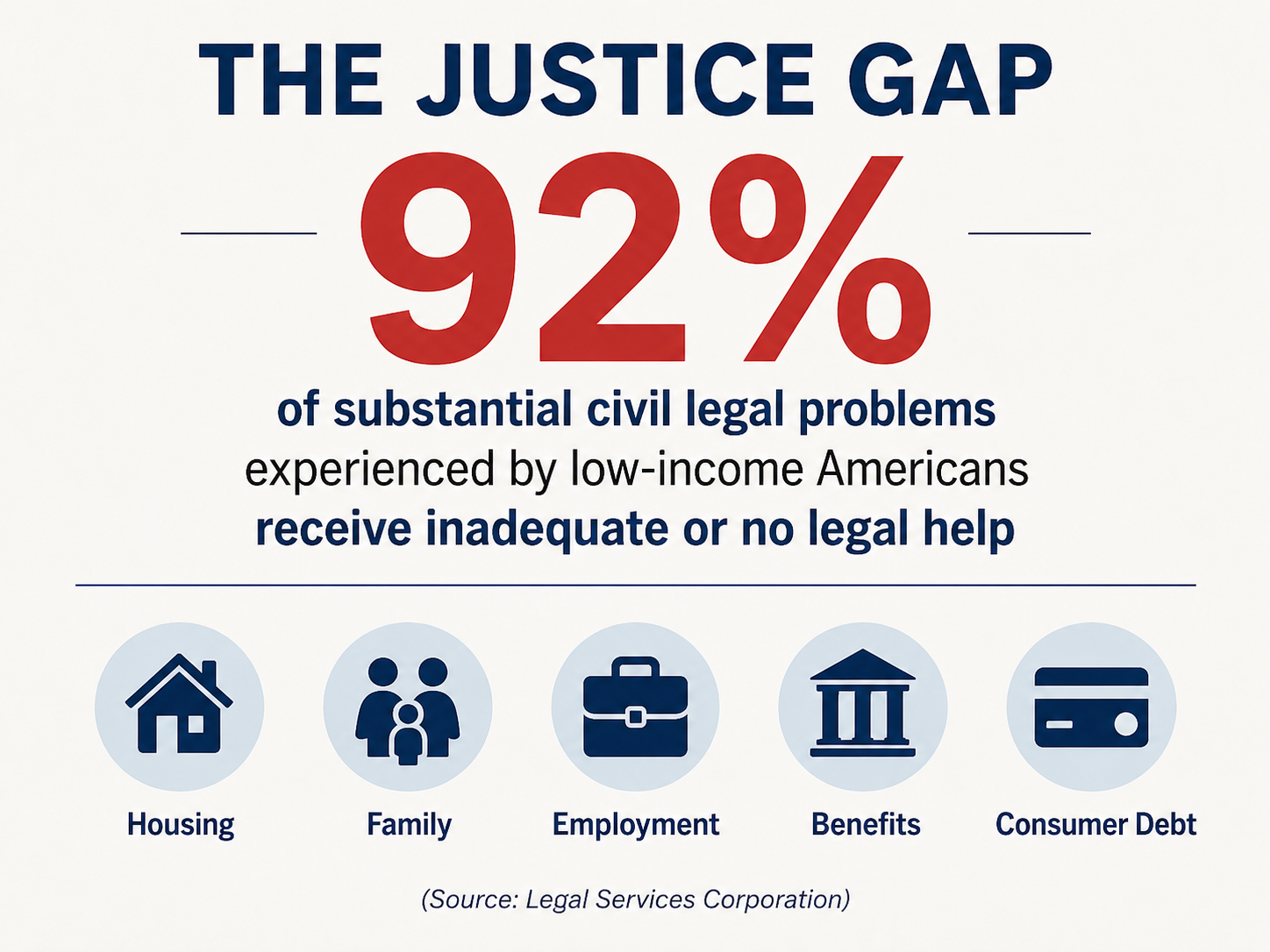
The Legal Services Corporation's Justice Gap study.
Its conclusion was difficult to ignore.
Low-income Americans receive inadequate or no legal help for approximately 92% of their substantial civil legal problems.
I read the sentence several times.
Then I read the list of legal issues included in the study.
They weren't unusual cases.
They were ordinary problems experienced by ordinary people.
Evictions
Child custody disputes
Foreclosures
Domestic violence protection orders
Employment disputes
Disability claims
Veterans' benefits
Consumer debt
The report didn't tell me Christy was right.
It didn't tell me she was wrong, either.
It simply suggested that millions of Americans struggle to obtain meaningful legal assistance when facing some of life's most important legal problems.
That seemed worth paying attention to.
The more I read, the less interested I became in proving a point.
I became interested in understanding one.
Was access to justice becoming another resource that some people could afford while others could not?
I still didn't know.
The interviews weren't finished.
Joseph answered differently than Christy.
But not as differently as I expected.
“People have a great sense of humor… That is far from the truth…”
"You're never innocent until proven guilty. You're guilty trying to prove your innocence."
Two people.
Different lives.
Different stories.
Yet both had answered the same question by talking about something I hadn't asked.
Money.
Not guilt.
Not innocence.
Money.
For the first time, the title of this investigation began to feel less like a provocative headline...
...and more like a question that deserved to be explored.
Joseph's answer stayed with me long after the interview ended.
Not because it confirmed what Christy had said.
Because it didn't.
The words were different.
The experiences were different.
Yet both had answered the same question by talking about something I hadn't asked.
Money.
Not guilt.
Not innocence.
Money.
If two people from different backgrounds arrived at similar conclusions, I wanted to understand why.
The next interview brought me a little closer.
THE PRICE OF A DEFENSE
Most people never expect to need a lawyer.
Legal problems have a way of arriving without warning.
A divorce.
An eviction notice.
A custody dispute.
A criminal charge.
A lawsuit.
Whatever the circumstance, the clock begins running immediately.
So do the expenses.
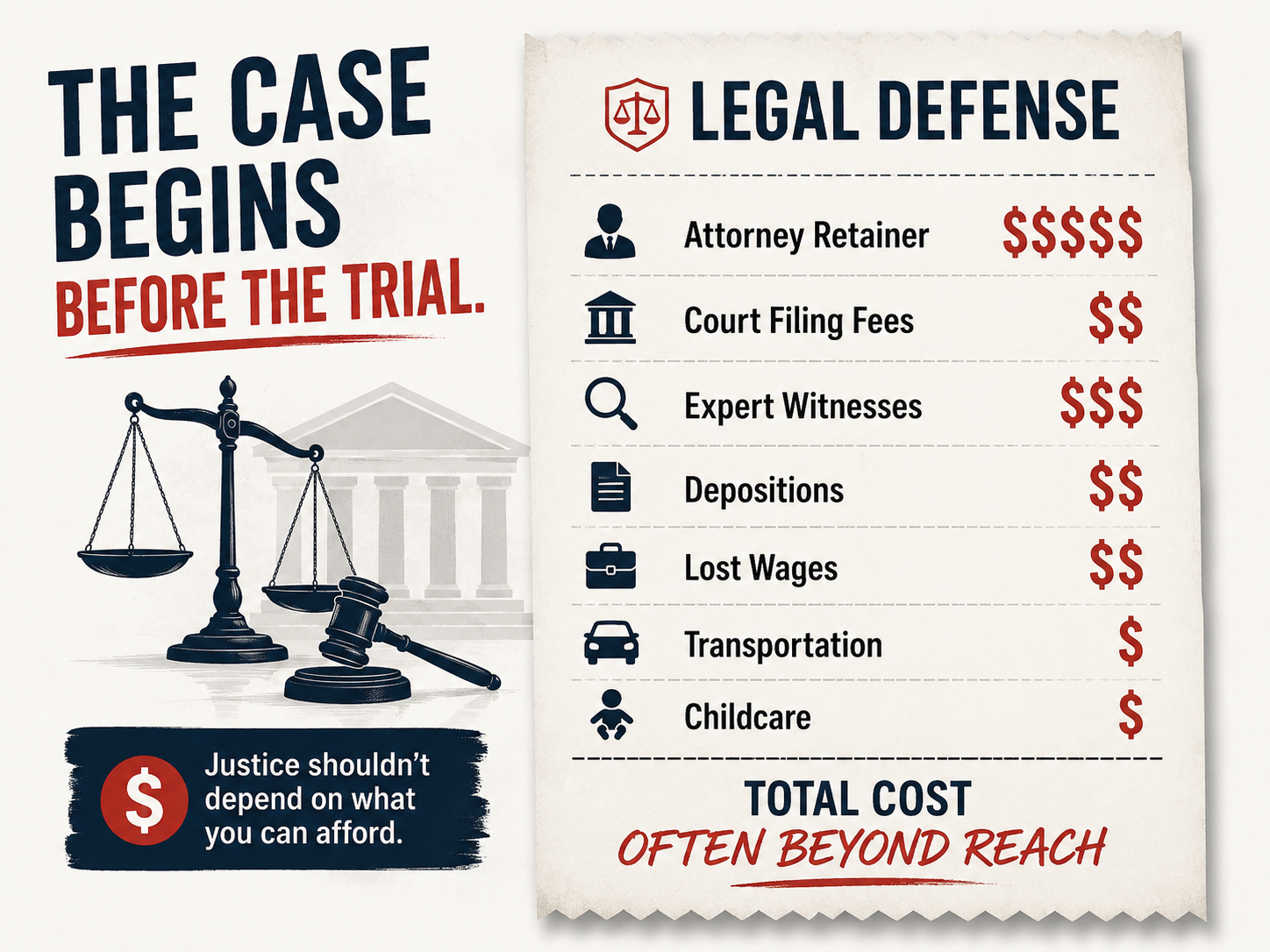
Attorney retainers often require thousands of dollars before meaningful work even begins.
Court filing fees.
Depositions.
Expert witnesses.
Certified records.
Transcripts.
Investigators.
And those are only the costs that appear on paper.
There are others that don't.
Time away from work.
Lost wages.
Gas.
Childcare.
Meals.
Missed opportunities.
Every hearing carries a cost, even if no invoice is ever mailed.
I wanted to know what those costs looked like to someone who had actually faced them.
Amy answered before I had even finished writing down the question.
There wasn't much to add after that.
A fifteen-thousand-dollar retainer.
For many families, that's more than several months of income.
Even if the exact amount varies from case to case, the point remained the same.
Legal representation can become financially out of reach long before a case ever reaches trial.
As I continued reading reports from legal aid organizations, I found the same concern repeated in different ways.
Millions of Americans face serious civil legal problems without professional representation—not because they don't want it, but because they cannot obtain or afford it.
The law doesn't become less important when money runs out.
Access to it does.
I kept coming back to the same thought.
If someone cannot afford legal advice, what choices remain?
Represent yourself?
Borrow money?
Accept a settlement?
Plead guilty?
Walk away?
None of those decisions happen in a vacuum.
Financial pressure has a way of changing what feels possible.
It doesn't decide every legal outcome.
But it can influence the choices people feel they have.
WHEN THE CASE FOLLOWS YOU HOME
Court doesn't end when you leave the courtroom.
Life keeps moving.
Rent is still due.
Bills still arrive.
Children still need to be fed.
Employers still expect you at work.
The legal process simply becomes another responsibility layered on top of everything else.
That became even clearer during my next conversation with Amy.
I asked whether her legal problems had affected anything beyond the courtroom.
She didn't talk about judges.
She didn't talk about attorneys.
She talked about where she was living.
I hadn't expected housing to become part of this investigation.
Until that moment, I had been thinking about attorney fees.
Amy reminded me that legal expenses rarely arrive alone.
Court costs.
Probation fees.
Transportation.
Time away from work.
Lost income.
One expense leads to another.
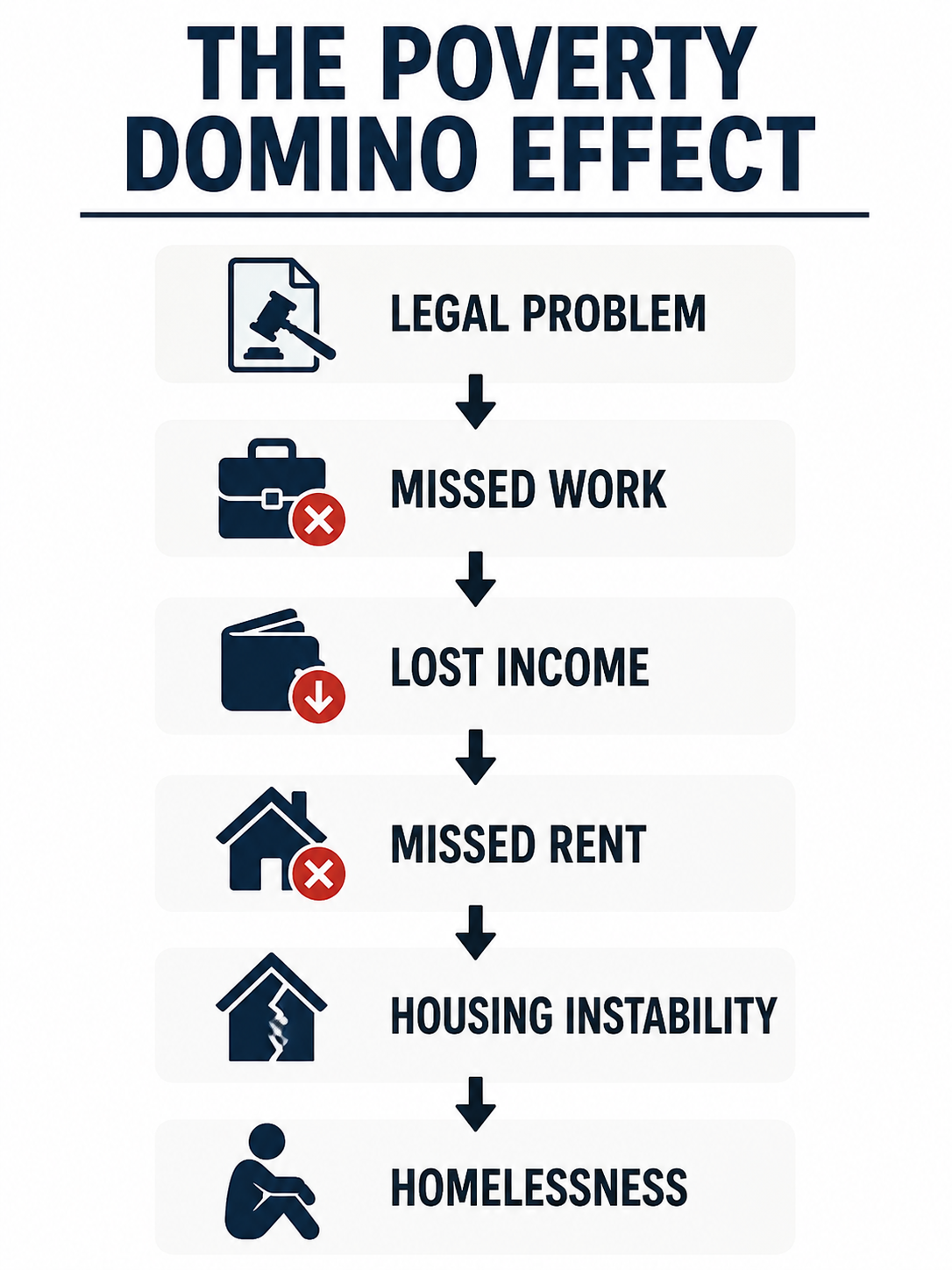
Eventually, what began as a legal problem can become something much larger.
The more I read, the more familiar that sequence became.
Researchers studying housing instability often describe crises not as isolated events, but as chains of events.
One setback makes the next one more likely.
Lose income.
Fall behind on rent.
Face eviction.
Lose stable housing.
Lose reliable transportation.
Miss work.
Miss court.
Each problem creates another.
Not because people stop trying.
Because every solution becomes harder than the one before it.
Joseph described it more simply than any report I read.
I replayed that answer several times while reviewing the interviews.
It wasn't dramatic.
It wasn't rehearsed.
It was matter-of-fact.
And perhaps that's what made it so powerful.
Homelessness doesn't erase obligations.
Court dates still exist.
Deadlines still arrive.
Paperwork still matters.
The difference is that every one of those responsibilities becomes more difficult without a place to live.
Research supports much of what Joseph described.
Stable housing affects nearly every aspect of participating in the legal system.
Receiving court notices.
Keeping documents.
Meeting with attorneys.
Attending hearings.
Without an address, even communication becomes another obstacle.
By the end of those conversations, I realized the article had quietly changed direction.
I thought I was investigating whether justice depends on money.
Instead, I found myself asking a different question.
How many legal problems become financial problems...
...and how many financial problems eventually become housing problems?
I didn't have the answer.
But I knew where the next conversation needed to go.
If access to justice depends on legal representation, what happens when that representation is available in theory—but stretched beyond its limits in practice?
That question led me to James, and to a conversation about public defense, military service, and what it means to navigate a legal system from the inside.
By the time I sat down with James, I had stopped expecting people to answer my question the same way.
Some talked about money.
Others talked about homelessness.
Some described frustration.
Others described confusion.
No two conversations sounded alike.
That was becoming the most interesting part of the investigation.
The people were different.
The experiences were different.
Yet many of them seemed to arrive at similar concerns through entirely different paths.
James brought another perspective I hadn't heard yet.
He had served in the military.
He had spent time in prison.
And he spoke about both without trying to dramatize either.
When I asked what the phrase "innocent until proven guilty" meant to him, he answered almost immediately.
His answer wasn't identical to the others.
But once again, legal representation found its way into the conversation.
By then I had heard variations of the same concern from four different people who had never met each other.
I wasn't interested in counting how many agreed.
I was interested in understanding why the topic kept returning.
That led me to one part of the justice system I hadn't fully appreciated before beginning this project.
Public defense.
WHO SPEAKS FOR THE DEFENSE?
One of the strongest protections guaranteed by the United States Constitution is the right to legal counsel in criminal prosecutions.
For millions of Americans, that promise is fulfilled by public defenders.
Their role is indispensable.
Every day, they represent people who would otherwise face the justice system alone.
The attorneys working in those offices carry enormous responsibility, often under difficult circumstances.
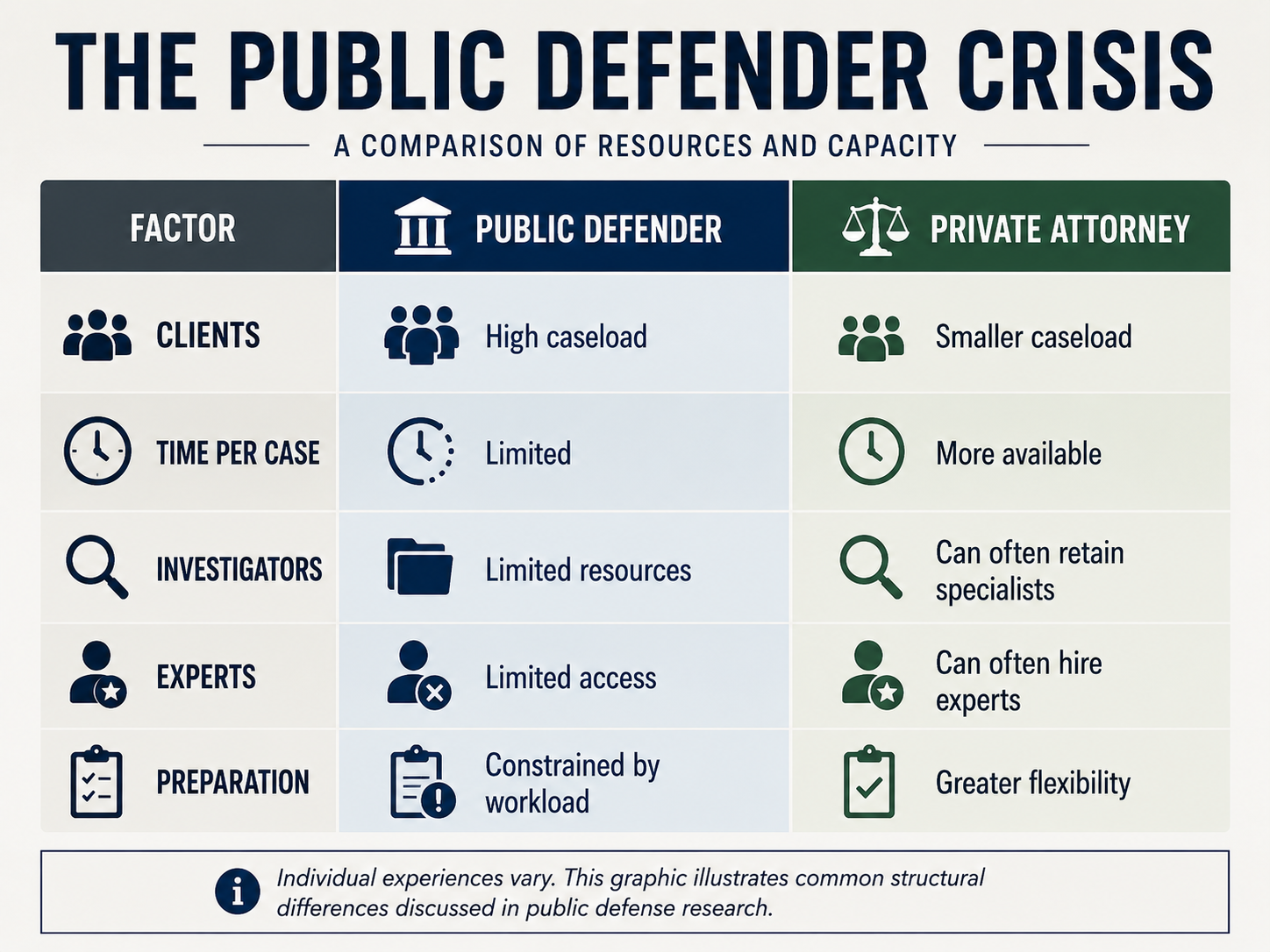
As I continued reading reports from legal organizations, one concern appeared repeatedly.
Not a lack of commitment.
A lack of resources.
Studies from organizations including the American Bar Association, the National Legal Aid & Defender Association, and RAND have documented longstanding concerns about excessive caseloads in many public defender offices.
The question raised by those reports isn't whether public defenders care.
It's whether they have enough time.
Enough investigators.
Enough support staff.
Enough hours in the day.
Amy had described her own experience in much simpler terms.
I thought about that statement for a long time before writing this section.
It would have been easy to present it as proof that the system doesn't work.
It isn't.
It's one person's experience.
At the same time, research documenting overwhelming workloads in some public defender offices suggests that her frustration isn't occurring in a vacuum.
Those two facts can exist together.
Public defenders can work tirelessly on behalf of their clients.
They can also be asked to carry more cases than any attorney reasonably should.
The problem, if there is one, may not be individual effort.
It may be capacity.
LEARNING THE LAW WHILE LIVING INSIDE IT
One moment from James' interview stayed with me more than anything else.
It wasn't his opinion.
It was his story.
He described keeping track of the days he had served.
Eventually, he believed something didn't add up.
According to his own calculations, he had already completed his sentence.
He remembered questioning why he remained incarcerated and trying to understand how sentencing calculations actually worked.
Whether every detail unfolded exactly as he understood it isn't something I could independently verify.
What I could verify was something broader.
Understanding the legal system is difficult.
For people without legal training, court procedures, sentencing rules, filing deadlines, appeals, and legal terminology can become overwhelming.
Several people I interviewed described feeling lost at different points in the process.
Research on access to justice reaches a similar conclusion.
The law is public.
Understanding it isn't always simple.
JUSTICE DOESN'T STOP AT THE COURTHOUSE
One realization kept resurfacing as I reviewed my notes.
Legal problems rarely stay inside courtrooms.
They spill into nearly every part of life.
Employment.
Housing.
Relationships.
Finances.
Mental health.
Sometimes the courtroom isn't where the greatest consequences occur.
Sometimes they're felt months later.
At work.
At home.
Or while trying to start over.
James spoke openly about rebuilding his life after prison.
Amy described trying to recover after losing housing.
Joseph talked about navigating everyday responsibilities without a permanent address.
Christy reflected on how her own experiences had changed the way she viewed the justice system.
Different stories.
Different lives.
The same question continued sitting quietly in the background.
What does equal justice actually look like when people begin from very different places?
LOOKING FOR ANSWERS, NOT SIDES
One thing surprised me while working on this article.
The people I interviewed weren't asking for special treatment.
They weren't asking to win every case.
Most weren't even talking about verdicts.
They were talking about the process.
Being heard.
Being understood.
Being able to afford representation.
Being able to keep up.
Being able to understand what was happening to them.
Those aren't the same thing as asking for a guaranteed outcome.
They're asking for a meaningful opportunity to participate in a system that can profoundly shape their lives.
That's a conversation worth having, regardless of where someone stands politically.
Because sooner or later, almost everyone will depend on some part of the legal system.
The question is whether they'll be able to navigate it when that day comes.
The final interviews brought me back to where this investigation began.
Not with statistics.
Not with legal theory.
With one last question.
If you could change one thing...
By the time I finished reviewing the interviews, my notebook was full.
Not with answers.
With questions.
When I first picked up the camera, I thought I was investigating a familiar phrase.
"Innocent until proven guilty."
Somewhere along the way, the investigation became something else.
Not a debate about guilt.
Not a debate about innocence.
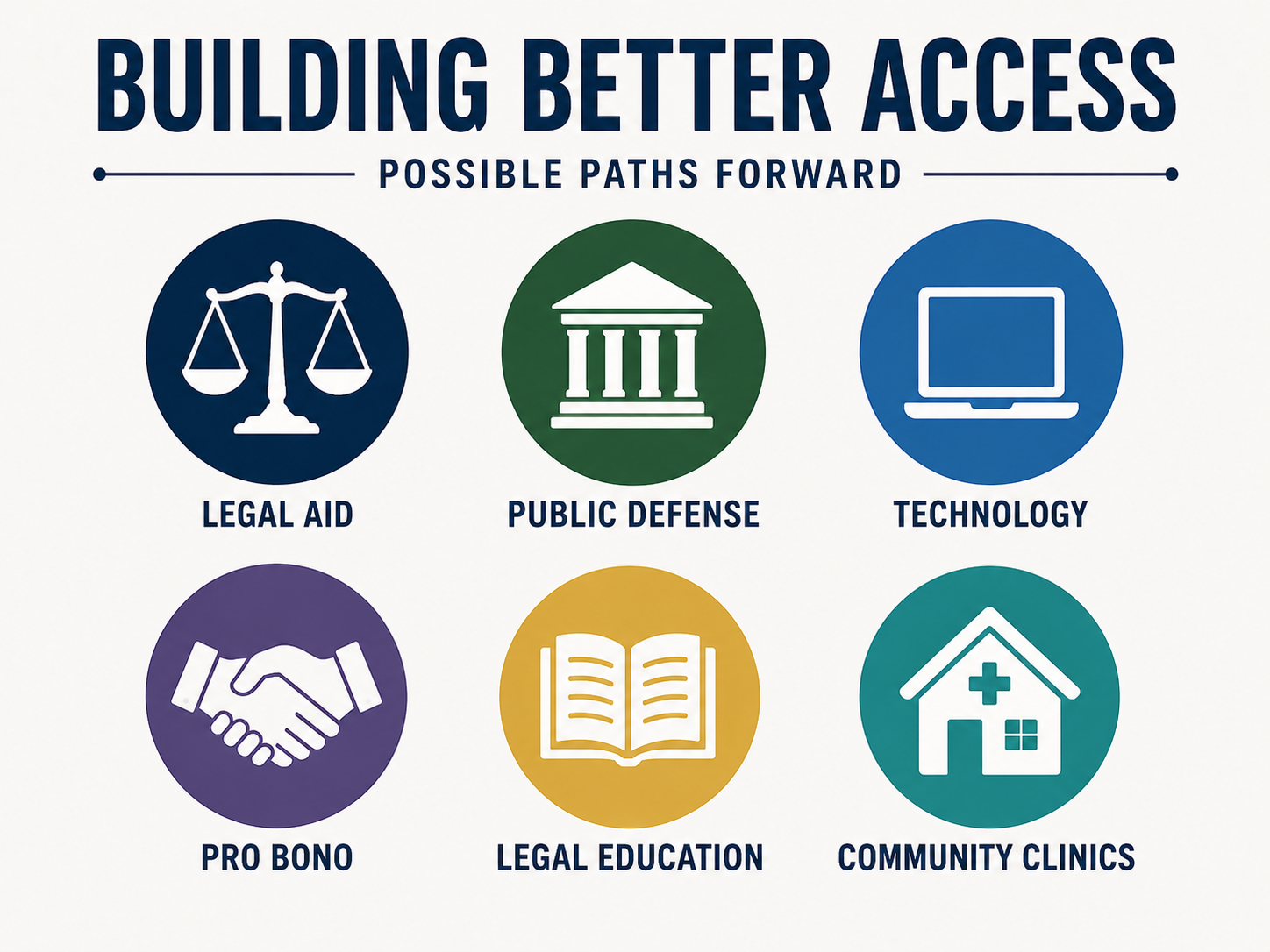
A conversation about access.
Access to lawyers.
Access to information.
Access to housing.
Access to time.
Access to the legal system itself.
Each interview revealed a different piece of that conversation.
No two stories were the same.
Yet each one challenged me to think about justice beyond the walls of a courtroom.
Before ending each interview, I asked one final question.
If you had one minute with Lawmakers, what would be your message?
Amy answered…
She wasn't asking for special treatment.
She wasn't asking for sympathy.
She was asking for consistency.
Whether readers agree with her conclusions or not, her answer reflected an idea that sits at the heart of the American legal tradition—that justice should depend on facts and law, not on a person's financial circumstances.
James answered the same question from a different perspective.
Instead of talking about fairness, he talked about representation.
His answer brought me back to something I had read days earlier while researching legal aid.
Rights exist on paper.
Access determines whether those rights can be exercised.
Those aren't the same thing.
One describes the law.
The other describes people's ability to use it.
That difference stayed with me long after the interviews ended.
WHAT THIS INVESTIGATION IS...
This investigation is not a statistical survey.
It is not a legal analysis.
It cannot tell us how every courtroom operates or how every judge rules.
Four interviews cannot answer questions that researchers have been studying for decades.
That was never the goal.
The goal was simpler.
To listen.
To compare those conversations with publicly available research.
To see whether ordinary people's experiences reflected questions already being asked by legal organizations, researchers, and policy experts.
In many cases, they did.
That doesn't mean every experience is universal.
It does suggest those experiences deserve to be taken seriously.
WHAT I LEARNED
When I started this project, I expected people to talk about verdicts.
Instead, they talked about everything that happens before one.
Finding an attorney.
Paying a retainer.
Missing work.
Keeping a home.
Understanding paperwork.
Making court dates.
Trying to keep life together while navigating a legal system that many described as confusing, expensive, and overwhelming.
None of those things determine guilt.
But they can shape how someone experiences justice.
Perhaps that distinction is more important than I understood when this investigation began.
THE QUESTION THAT REMAINS
I still believe in the principles that inspired this investigation.
That every person deserves due process.
That the burden of proof matters.
That everyone should stand equal before the law.
Those ideals are worth protecting.
The interviews didn't convince me to abandon those principles.
They convinced me to ask whether everyone has the same opportunity to benefit from them.
Research alone cannot answer that question.
Neither can four interviews.
But together they point toward something worth examining more closely.
If access to justice is influenced by financial resources...
If millions of Americans struggle to obtain meaningful legal assistance...
If navigating the legal system becomes dramatically harder without stable housing, transportation, or income...
Then perhaps the conversation isn't simply about whether justice exists.
Perhaps it's about whether justice is equally accessible.
I don't know if the answer is yes.
I don't know if the answer is no.
But after listening to these stories...
I don't think the question can be ignored.
SOURCES
Legal Services Corporation — The Justice Gap: The Unmet Civil Legal Needs of Low-Income Americans
American Bar Association — Resources on Access to Justice and Public Defense
Bureau of Justice Statistics
Prison Policy Initiative
National Legal Aid & Defender Association
RAND research on public defense
National Coalition for a Civil Right to Counsel
Florida court system publications and publicly available reports on access to justice
AUTHOR'S NOTE
This article grew out of a simple question asked to six strangers.
Their experiences are their own and should not be understood as representing every person's interaction with the justice system. Throughout this investigation, I compared those conversations with publicly available research to explore whether broader evidence reflected similar concerns.
The purpose of this piece is not to offer a final answer.
It's to encourage a conversation that I believe is worth having.
Because justice is one of the few institutions every one of us may depend on someday—and the questions we ask about it today shape the confidence we place in it tomorrow.
