
The PRICE of FREEDOM
How America’s Jail System Punishes Poverty Before Trial
JUSTICE HAS A PRICE TAG
In the United States, freedom is often framed as a fundamental right.
But for millions of people each year, freedom has a price—and if you cannot afford it, you lose it.
On any given day, hundreds of thousands of individuals sit in county jails across America not because they have been convicted of a crime, but because they cannot afford bail. According to the Prison Policy Initiative, nearly 70% of people in U.S. jails are pretrial detainees, legally presumed innocent.
Their detention is not based on guilt.
It is based on poverty.
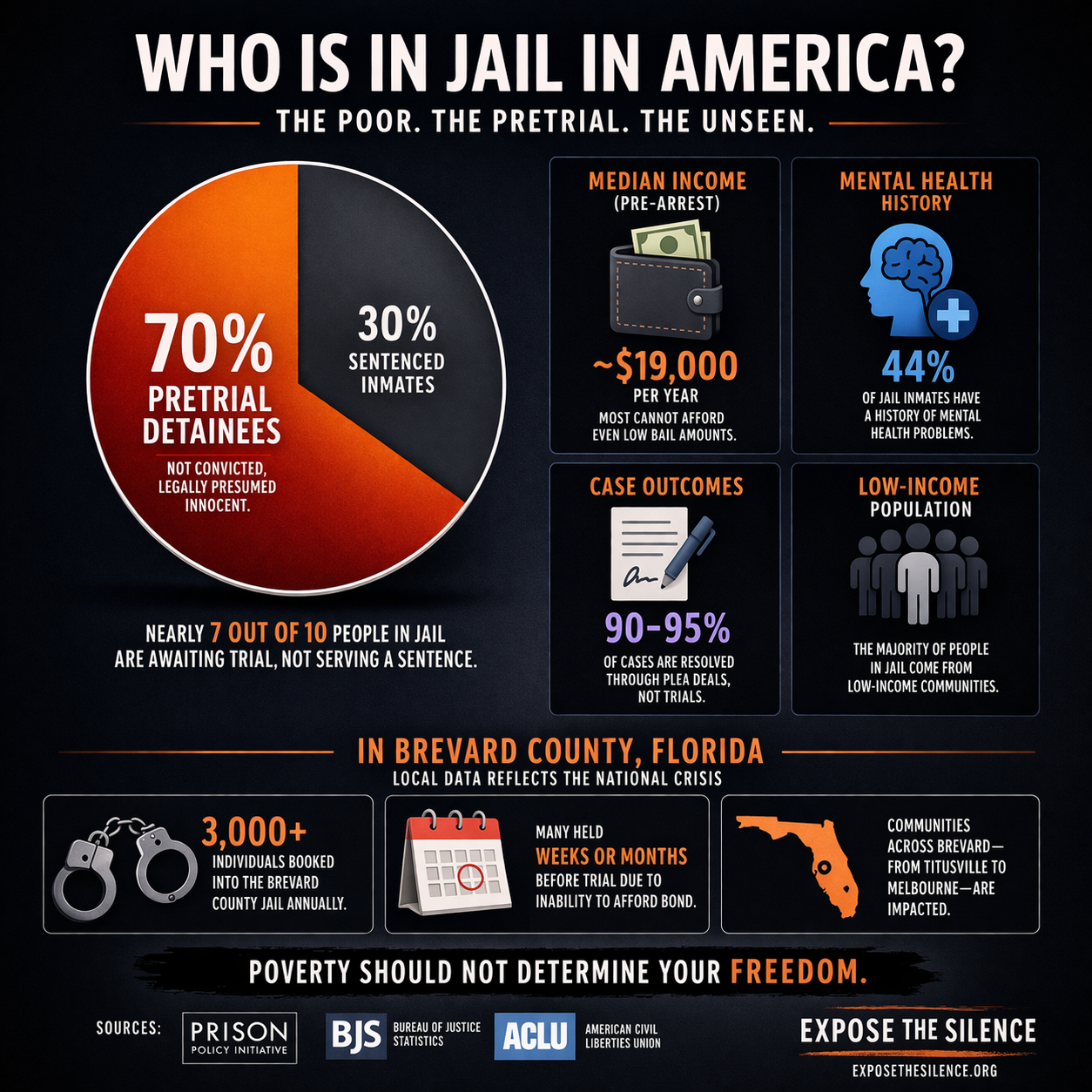
Local data reflects a broader national pattern, where pretrial detention disproportionately affects low-income individuals and extends incarceration beyond conviction.
THE BAIL SYSTEM: DETENTION BY INCOME
The American bail system was designed to ensure court appearance. In practice, it has evolved into a mechanism that disproportionately detains the poor.
Data from the Bureau of Justice Statistics shows that the median annual income of individuals incarcerated prior to arrest is less than $20,000. For many, even a few hundred dollars in bail is unattainable.
This creates a two-tier system of justice:
Those WITH financial resources secure release and prepare their defense
Those WITHOUT resources remain incarcerated, often for weeks or months
Research consistently shows that pretrial detention increases the likelihood of conviction, not because of guilt, but because of pressure.
As the American Civil Liberties Union has argued, cash bail effectively criminalizes poverty by turning financial status into a determinant of liberty.
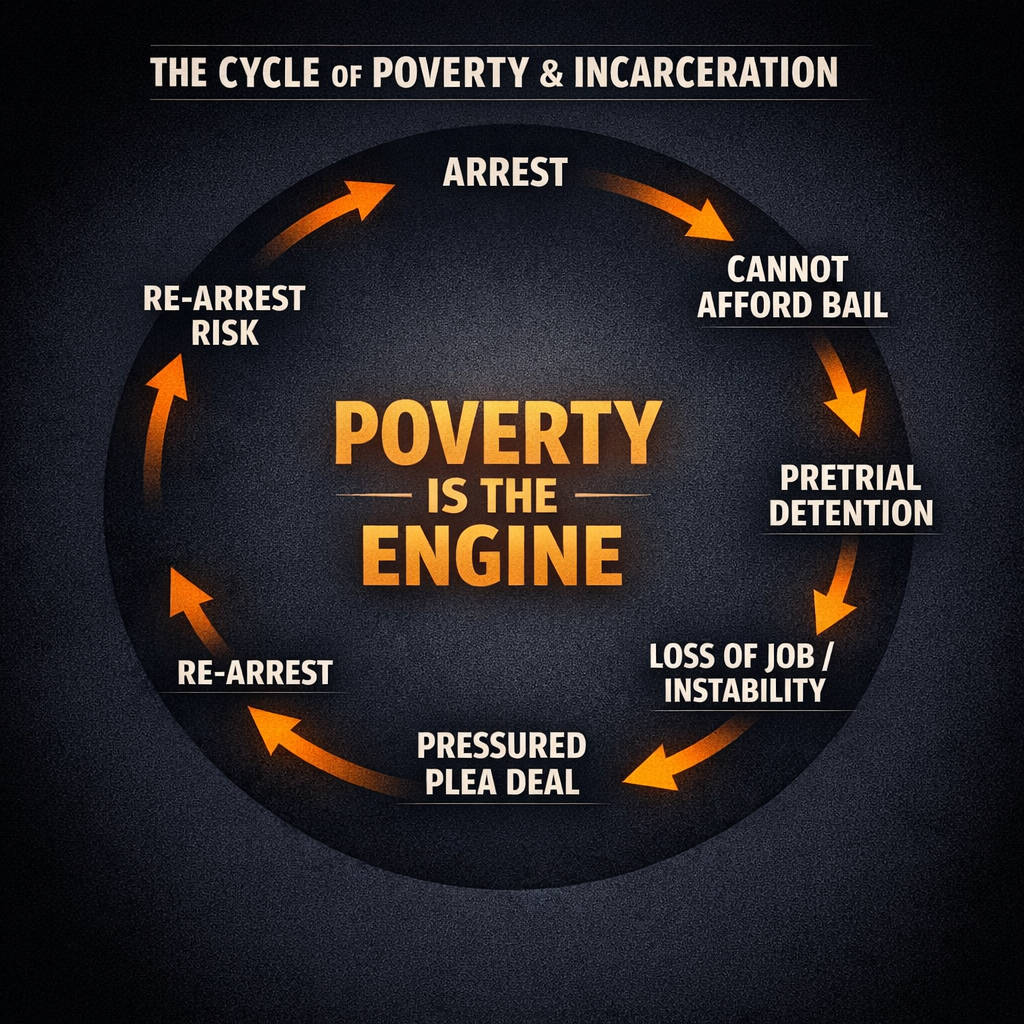
Pretrial detention, economic instability, and plea pressure form a self-reinforcing cycle in which poverty drives outcomes at every stage of the justice process.
INSIDE THE JAIL: CONDITIONS OF CONFINEMENT
While awaiting trial, detainees are subjected to conditions that raise serious constitutional concerns.
Investigations by Human Rights Watch and multiple civil rights organizations have documented:
Overcrowded and unsanitary environments
Limited access to sunlight and outdoor activity
Inadequate nutrition
Extreme temperature conditions
Limited or delayed medical care
The legal standard governing these conditions was shaped by Farmer v. Brennan, which established that prison officials violate the Eighth Amendment when they show “deliberate indifference” to inmate safety.
Yet despite this precedent, systemic neglect remains widespread.
When harmful conditions are normalized across entire facilities, the distinction between negligence and policy becomes increasingly blurred.
SURVIVAL FOR SALE: THE ECONOMICS OF INCARCERATION
Inside jail, survival often depends on access to money from outside.
Basic necessities—such as hygiene products, additional food, and communication—are frequently only available through commissary systems. These goods are often sold at inflated prices.
A report by the Prison Policy Initiative found that incarcerated individuals and their families spend billions annually on commissary items, phone calls, and fees.
This creates an internal economic hierarchy:
Individuals with outside financial support can supplement inadequate provisions
Those without support endure significantly harsher conditions
The system effectively extends punishment beyond incarceration, placing financial strain on already vulnerable families.
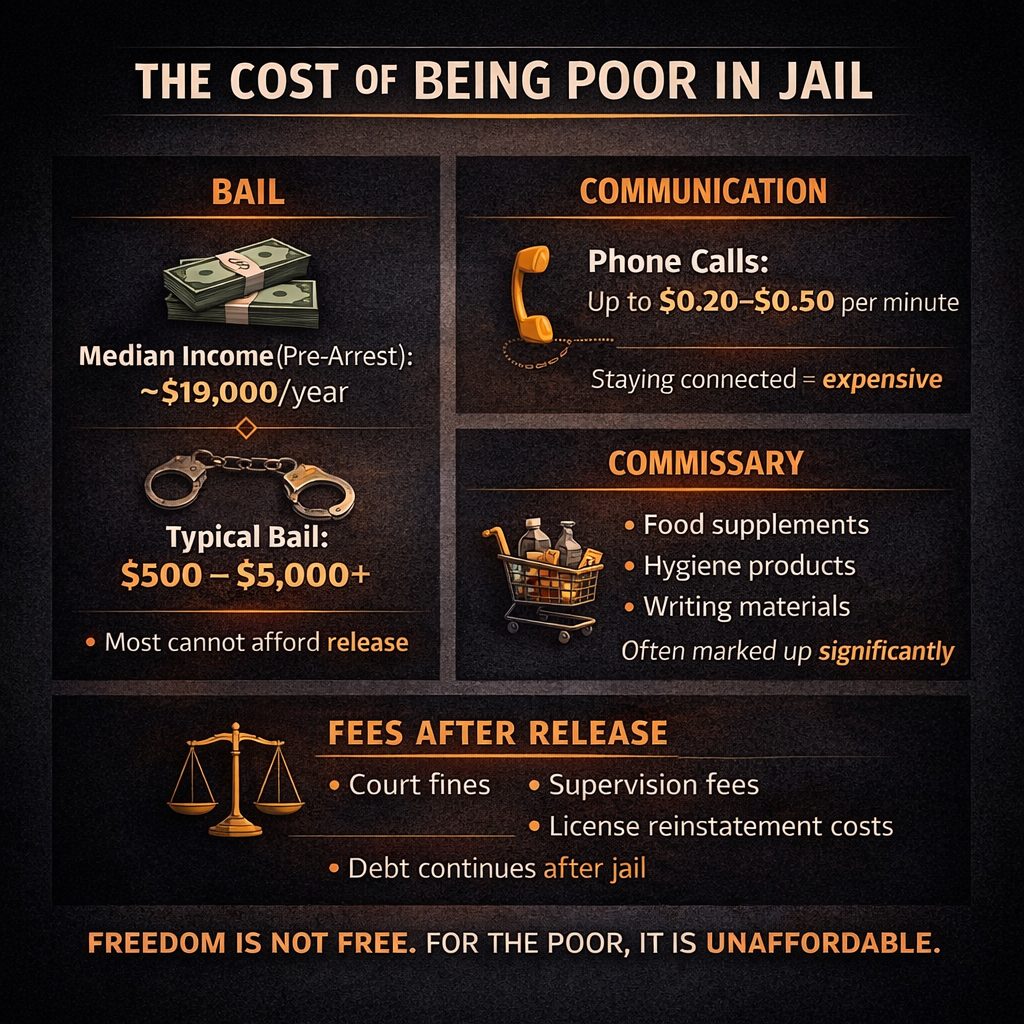
From bail to basic necessities, incarceration creates a system where survival depends on financial resources—extending punishment beyond detention and into long-term economic hardship.
MENTAL HEALTH: A SYSTEM IN CRISIS
Mental illness is disproportionately represented in jail populations.
According to the Bureau of Justice Statistics, approximately 44% of jail inmates have a history of mental health problems.
Despite this, access to meaningful treatment remains limited.
Reports from American Civil Liberties Union indicate:
Shortages of mental health professionals
Delays in evaluation and treatment
Reliance on isolation rather than care
Without proper intervention, incarceration exacerbates existing conditions, often leading to deterioration rather than rehabilitation.
THE PLEA BARGAIN PRESSURE
The overwhelming majority of criminal cases in the United States are resolved through plea agreements.
Estimates suggest that over 90% of cases end in guilty pleas.
For pretrial detainees, the decision is often shaped less by legal strategy and more by survival.
Remaining in jail while awaiting trial can mean:
Continued exposure to harsh conditions
Loss of employment
Separation from family
Psychological strain
Faced with these realities, many accept plea deals—including for offenses they might otherwise contest—simply to secure release.
This raises critical questions about the voluntariness of such pleas within a system defined by coercive conditions.
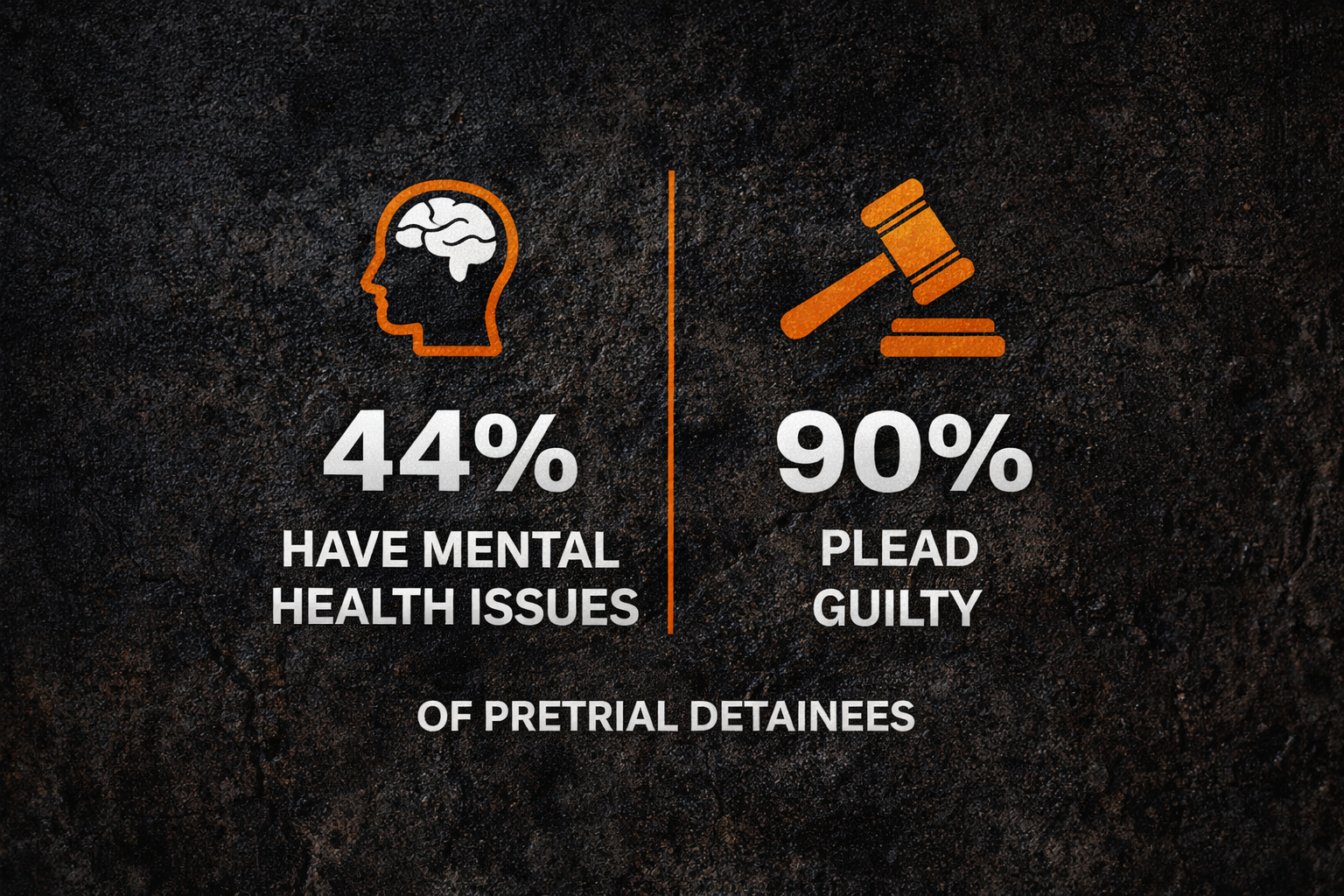
Nearly half of jail detainees report mental health challenges, while the vast majority of cases are resolved through plea agreements—highlighting how pretrial detention pressures outcomes before trial.
REENTRY: FREEDOM WITH CONSEQUENCES
Release from jail does not end the impact of incarceration.
Individuals often leave with:
Court-imposed fines and fees
Suspended driver’s licenses for nonpayment
Limited employment opportunities due to criminal records
The Prison Policy Initiative highlights how these barriers contribute to a cycle of instability, increasing the likelihood of re-arrest.
Without access to stable housing, employment, and support, many individuals face structural obstacles that make reintegration difficult.
PERSONAL TESTIMONY: A SYSTEM EXPERIENCED
Beyond the data lies lived experience.
I have seen firsthand how the system operates—not as a pathway to justice, but as a process that strips individuals of dignity and agency.
Inside, you are not treated as a person navigating a legal process.
You are processed.
Time slows. Access disappears. Your ability to advocate for yourself diminishes with each passing day.
And eventually, the question is no longer whether you are innocent or guilty.
The question becomes:
How much more can you endure?
A SYSTEM OF REINFORCEMENT, NOT REHABILITATION
The structure of pretrial detention, economic exploitation, and post-release barriers forms a cycle:
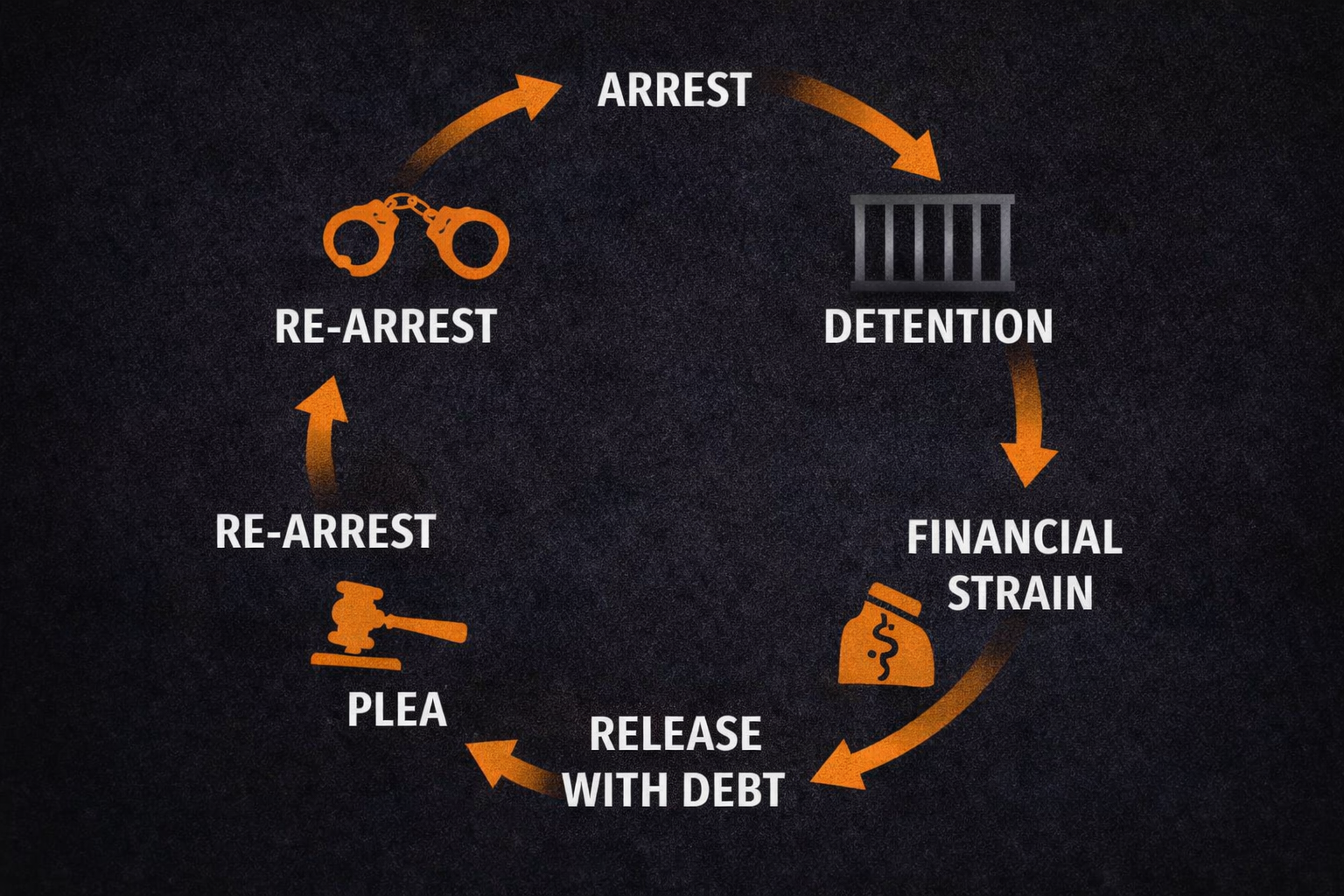
The structure of pretrial detention, financial strain, and post-release barriers creates a self-reinforcing cycle in which poverty increases the likelihood of continued incarceration.
This cycle disproportionately affects low-income individuals, reinforcing inequality at every stage.
While the system is often described as broken, the consistency of these outcomes suggests otherwise.
It functions with precision.
CONCLUSION: EXPOSING THE SILENCE
The American justice system is built on the principle of fairness under the law.
Yet for many, the experience of that system is defined not by fairness, but by financial capacity.
Until pretrial detention is no longer determined by income…
Until conditions of confinement meet constitutional standards…
Until release does not lead to systemic barriers…
The cycle will continue.
And the silence surrounding it will persist.
